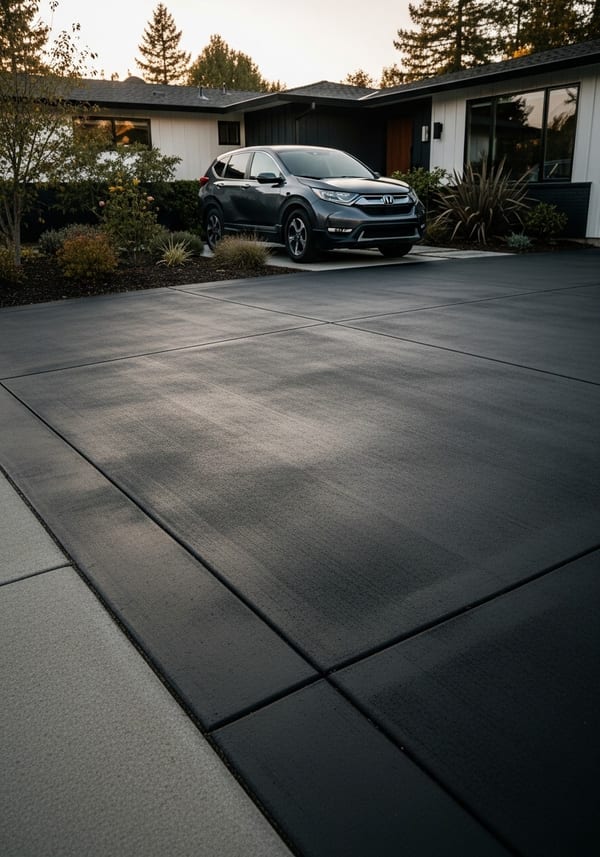
A circular concrete driveway typically costs $15,000–40,000 installed, depending on size, finish, and site conditions. That's a significant investment — justified when the property has the frontage to support it and curb appeal is a real priority. Done well in stamped or exposed aggregate concrete, a circular driveway is one of the most visually distinctive exterior upgrades possible. These ideas cover pattern choices, layout decisions, and the one sizing rule you can't ignore. For context on costs, the same per-sq-ft pricing logic from standard driveway work applies — with a complexity premium for curved forming.
Cobblestone-Stamped Circle
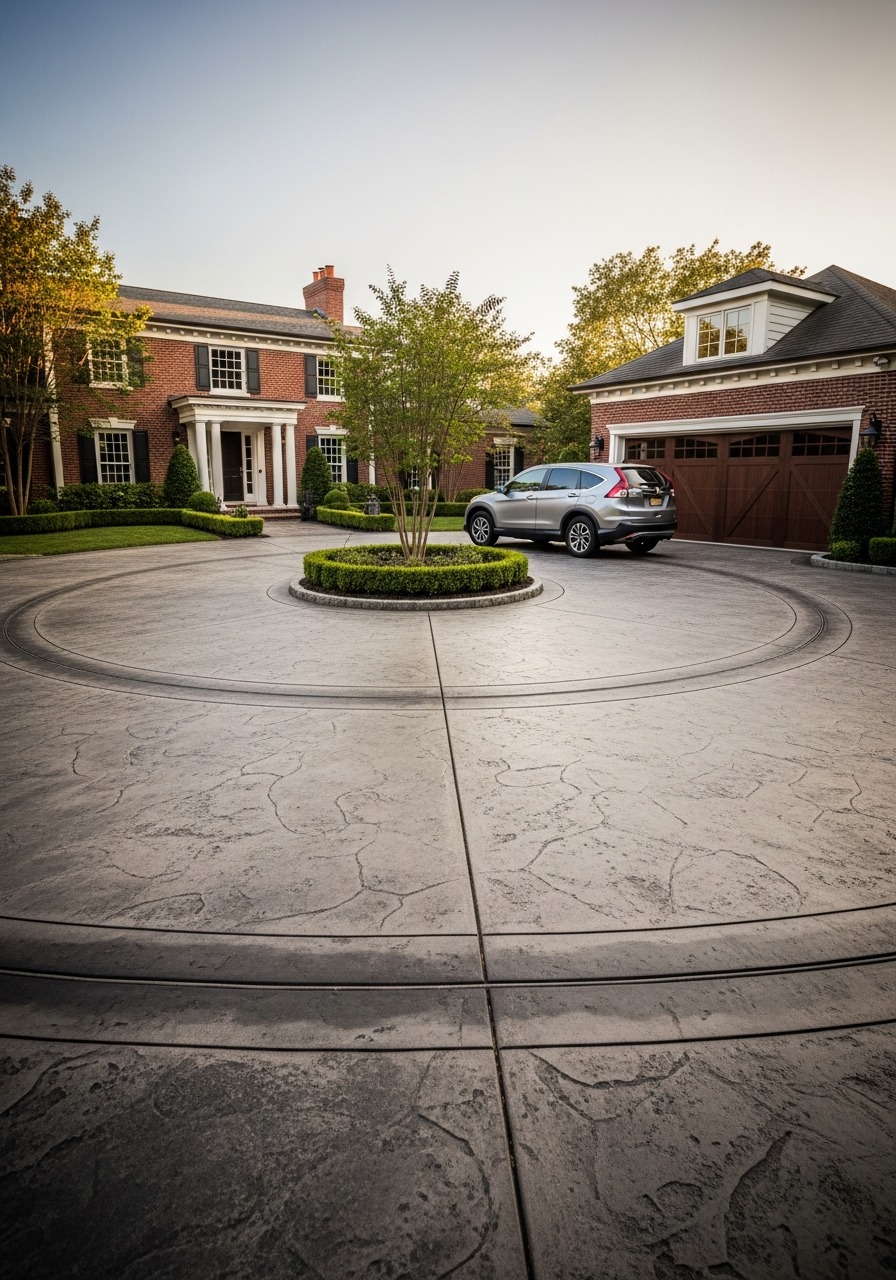
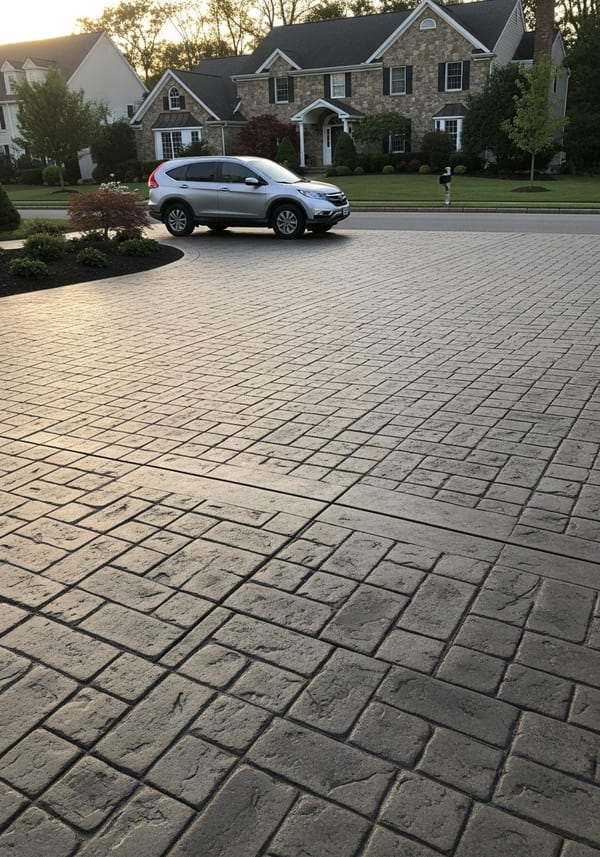
Cobblestone stamping on a circular driveway is the classic choice — it reads as upscale, suits traditional and colonial homes, and the curved layout emphasizes the pattern. Color wash in an aged-iron or antique gray tone pulls the look together. At $14–20/sq ft for cobblestone stamping, a 1,000–1,500 sq ft circular driveway runs $14,000–30,000 — before the landscaped island.
Stamped vs. Exposed Aggregate: Which Works Better on a Curve
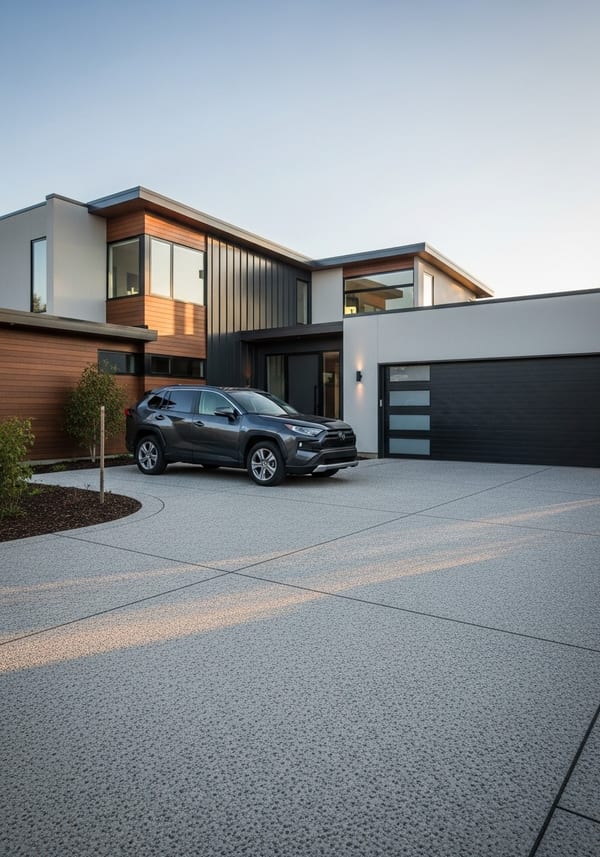
Stamped concrete on a circular driveway requires precise alignment at the curved edges — the pattern must be cut cleanly rather than wrapped. This adds forming complexity and labor cost. Exposed aggregate ($8–14/sq ft) handles curves more naturally because it has no directional pattern, and the textured surface reads well against the curved border. Choose stamped for maximum visual impact; choose exposed aggregate for a cleaner, lower-risk execution.
Two-Tone Concrete
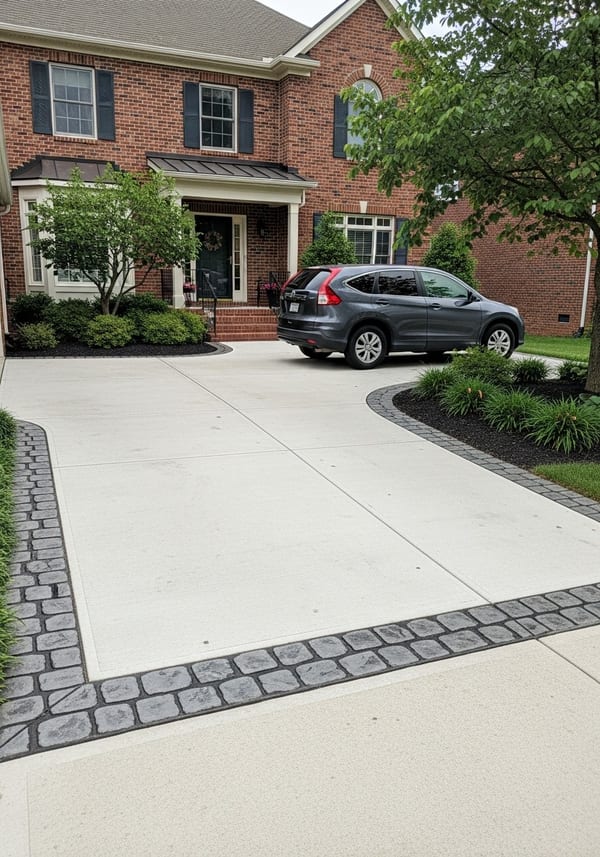
A two-tone approach uses one color for the main driveway lanes and a contrasting color for the circular center island border or the apron band. This defines the layout clearly and adds visual structure without requiring a complex stamp pattern. It's one of the more budget-friendly ways to achieve a designed look on a circular layout — typically $8–12/sq ft versus $14–20 for a fully stamped surface. A charcoal field with a light grey or buff border reads well from the street.
Landscaped Center Island
The center island of a circular driveway is its visual anchor — and the most commonly underinvested element. A raised island with structured planting (a single specimen tree, ornamental grasses, or a formal low-hedge border) ties the driveway design to the landscape and prevents the center from feeling like an empty concrete donut. Budget $2,000–8,000 for island landscaping on top of the concrete work. An irrigation system for the island, if needed, adds another $500–2,000 but is worth including while the concrete contractor is already mobilized.
Get the full inspiration pack — free.
30+ curated patio, driveway and walkway design images delivered to your inbox.
Sizing: The One Rule You Can't Ignore
A functional circular driveway needs a minimum inside radius of 18–20 feet to accommodate standard vehicles comfortably. The driveway lanes should be at least 10–12 feet wide. These minimums mean a circular driveway requires meaningful frontage — it's not a design for narrow urban lots. If you're also planning a patio in the rear, PourCanvas can help you visualize how both projects might look together before committing to either.
Drainage Planning for Circular Driveways
A circular driveway creates a large impervious surface that generates significant stormwater runoff. Most municipalities require demonstration of adequate drainage before permitting a circular driveway installation. Options include directing runoff to existing storm drain connections, installing a French drain system around the driveway perimeter ($15–30/linear foot installed), or grading the center island for infiltration if soil conditions allow. The drainage plan should be developed before the final layout is finalized — the driveway slope and grading must direct water away from the home foundation and toward the permitted drainage outlet. Budget $1,500–5,000 for drainage infrastructure on a typical circular driveway project; this is separate from the concrete cost and is rarely optional.
Circular Driveway Maintenance: What to Budget
A circular driveway with 1,000–1,500 sq ft of stamped or colored concrete requires resealing every 2–3 years at $300–750 per application professionally applied. The center island landscaping needs seasonal maintenance (pruning, mulching, irrigation if installed). Edge cracking is more likely on a circular driveway than a straight one because curved slabs have more complex stress patterns — inspect the outer edge radius annually and fill hairline cracks before winter in freeze-thaw climates. Over a 10-year period, budget $2,000–5,000 in maintenance costs for a well-maintained circular stamped concrete driveway — roughly 5–10% of the installation cost. Connect the driveway to a front walkway using the same finish material to complete the curb appeal picture.
Circular Driveway ROI and Resale Considerations
A circular driveway adds significant perceived value to a property when it suits the home's scale — a circular drive on a larger traditional home can add $15,000–40,000 in perceived value according to real estate agents who work in affluent suburban markets. The return on a smaller home or a suburban property that doesn't have the frontage to make the circular layout look natural is minimal, and it can actually read as overbuilt for the setting. The ROI calculus depends on the property price point: on a $400,000 home, a $35,000 circular driveway is difficult to recover at resale. On a $900,000+ home, the same investment is more proportionate to the property tier and buyer expectation. Use PourCanvas to visualize what the circular layout looks like in the context of your actual home and frontage before committing to the investment.
Front Walkway Integration on a Circular Driveway Property
Properties with circular driveways typically have a front entry that's accessed from the center of the circular loop rather than from the street. The front walkway on these properties often functions as a short, formal connection from the island to the front door — 10–20 feet rather than the typical 30–40 foot front path. The walkway finish should match the driveway finish for visual continuity; on a cobblestone circular drive, a matching cobblestone-stamped walkway from the inner island to the front door reads as intentional and complete. The patio, if present, is typically at the rear and can use a different but related finish — the front exterior cohesion is the priority for a circular drive property.