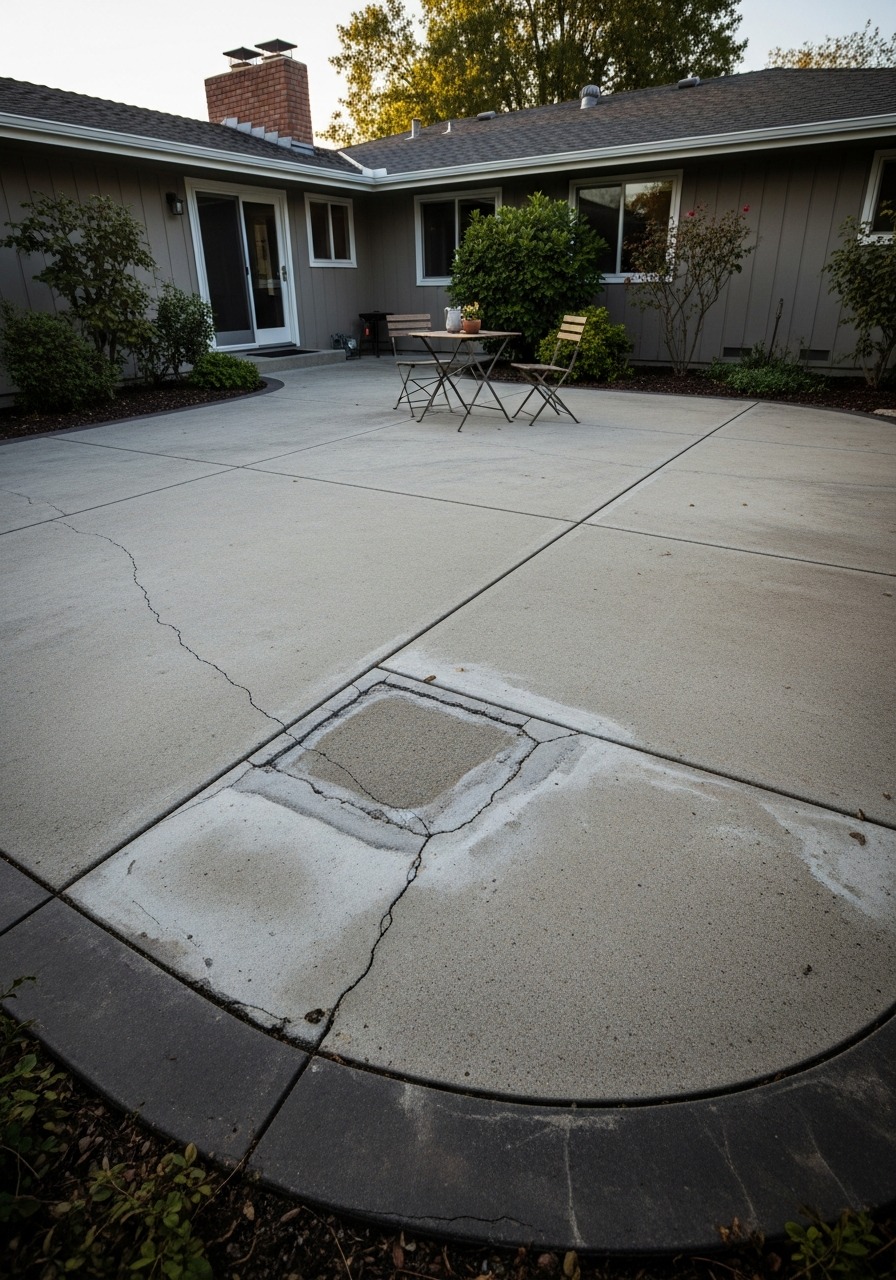
Concrete patio crack repair costs $100–500 in materials for a DIY job, or $300–1,500 for a professional repair depending on the number and severity of cracks. Whether you repair or replace depends on two things: crack width and whether the slabs on either side of the crack are level. Hairline and stable cracks can be repaired invisibly. Shifting or wide cracks signal a structural problem that repair won't solve. Here's how to read your cracks and make the right call — the same assessment applies to concrete driveways and walkways.
Hairline Cracks: Fix Them Now, Cheaply
Hairline cracks (under 1/8" wide, slabs level on both sides) are the easiest repair — and the most important to catch early. Water infiltrating a hairline crack expands during freeze-thaw cycles, widening the crack from the inside. A quality polyurethane crack filler or concrete caulk costs $15–30 per tube at any hardware store and is a DIY job. One tube handles 10–15 linear feet of hairline cracks. Apply to a clean, dry surface, tool flush with the surrounding concrete, and let cure for 24 hours before foot traffic. Early treatment at this stage prevents a $20 repair from becoming a $2,000 replacement.
Cracks Under 1/4": Repair or Resurface
Cracks up to 1/4" wide with slabs sitting level are repairable, but they're at the threshold where the repair will be visible. A v-grooved crack (widened slightly with a grinder for better product adhesion) filled with epoxy injection or flexible polyurethane filler holds longer than a surface-applied filler on a wider crack. Professional crack repair in this range typically costs $150–400 per crack, including surface prep and the repair compound. For a patio with multiple cracks in this range, a resurfacing overlay ($3–7/sq ft) may be more cost-effective than individual repairs — it addresses all of them at once and creates a uniform surface.
Shifting or Wide Cracks: Replace, Don't Repair
If the slab sections on either side of a crack are at different heights — even 1/4" of differential — the soil or base beneath the slab has moved. Filling the crack surface is not a fix; it's a cosmetic cover that will reopen within a season or two. The same is true for cracks wider than 1/4" that are actively growing. These conditions require either mudjacking (injecting grout beneath the slab to re-level it, $500–1,500 for a patio) or full slab replacement ($6–18/sq ft). A contractor can assess whether the base movement is ongoing or stable — if stable, mudjacking is a legitimate repair; if active, replacement is the only durable solution.
Get the full inspiration pack — free.
30+ curated patio, driveway and walkway design images delivered to your inbox.
Resurface vs. Repair: When an Overlay Makes More Sense
If your patio has multiple cracks, surface spalling, or significant staining in addition to cracks, a concrete overlay ($3–7/sq ft for plain; $8–15/sq ft for decorative) addresses all problems at once rather than chasing individual repairs. The overlay bonds to the existing slab, creates a fresh surface, and can be stamped or colored to transform the patio's appearance entirely. The condition for this to work: the existing slab must be structurally sound and level — no shifting, no significant heaving. An overlay on a moving slab will crack in the same locations within a year.
DIY vs. Hiring a Contractor for Crack Repair
DIY crack repair is appropriate for hairline and stable cracks under 1/8": the materials are inexpensive, the technique is straightforward, and the stakes are low if you don't get it perfect the first time. Cracks 1/8"–1/4" can be DIY'd but benefit from a contractor's v-groove preparation and injection technique, which extends repair longevity. Shifting cracks and resurfacing work should be left to contractors — both require proper diagnosis and execution that significantly impacts long-term results. For context: a professional resurfacing overlay on a 300 sq ft patio runs $900–4,500, compared to $1,800–5,400 for full replacement. Tools like PourCanvas can help you visualize what your patio would look like with a fresh overlay or a new surface before committing to either approach.
Preventing Future Cracking
Most patio cracking is preventable. Proper control joint placement (every 8–12 feet in each direction) gives the slab a place to crack along planned lines rather than randomly. A 4" slab with a well-compacted gravel base handles freeze-thaw cycles significantly better than a thin pour on unstable soil. Sealing every 2–3 years (or 4–5 years for plain surfaces) prevents water infiltration that drives freeze-thaw cracking. And keeping tree roots away from the slab edge — or installing root barriers at pour time — prevents the most common cause of heaving and crack propagation in established landscapes. If you're also planning a driveway, the same base prep and joint standards apply.
When Crack Repair Is a Temporary Fix vs. a Permanent Solution
Not all crack repairs are equal in their lifespan. A properly executed epoxy injection on a stable, level hairline crack can last 20+ years — the repair may genuinely outlast the surrounding surface. A polyurethane fill on a 1/4" crack with slight height differential will re-open within 2–5 years as the underlying movement continues. The key variable is whether the cause of the crack has been resolved: soil movement, tree root pressure, and drainage problems are ongoing unless addressed directly. Filling the crack surface without resolving the root cause is a cosmetic deferral. When a contractor quotes crack repair, ask whether the cause of cracking is addressed in the scope — and if not, what the expected re-crack interval is with the proposed repair. The same question applies to driveway and walkway cracks: a $400 repair on a structurally sound slab is money well spent; the same $400 on an actively moving slab is a temporary visual fix. Documenting crack locations with photos annually helps you track whether movement is ongoing — a crack that doesn't grow over 12 months is typically stable and suitable for permanent repair.