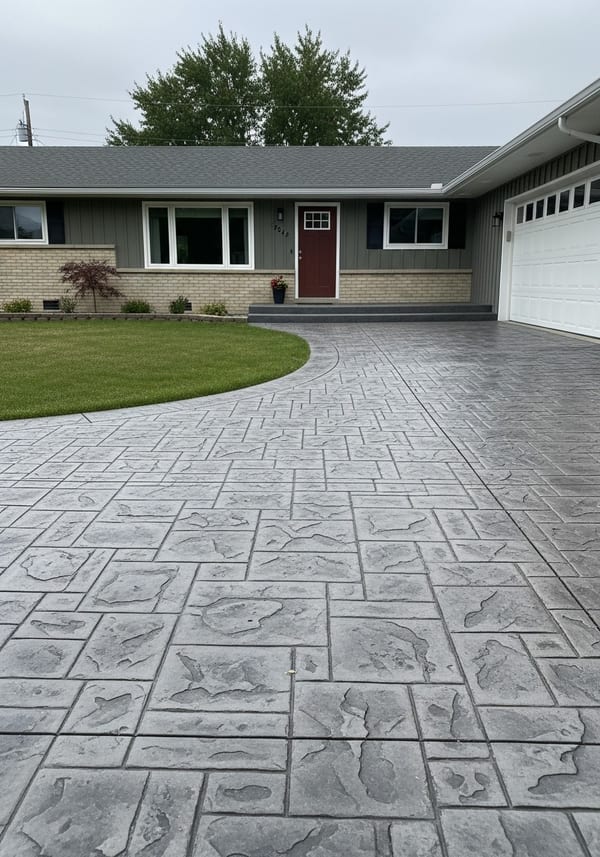
A curved concrete walkway costs 10–20% more than a straight one of the same finish — typically an extra $100–400 on a standard front walk — due to forming complexity. Whether that premium is worth it depends on your lot and landscape. Curved walkways read as more intentional when there's a landscape reason for the curve; without one, they can feel arbitrary. Here's how to make a curve work, which patterns suit it, and when a straight path is actually the stronger design choice. The same curve-vs-straight decision applies to concrete pathways through a patio or rear garden.
Gentle Arc vs Winding Path
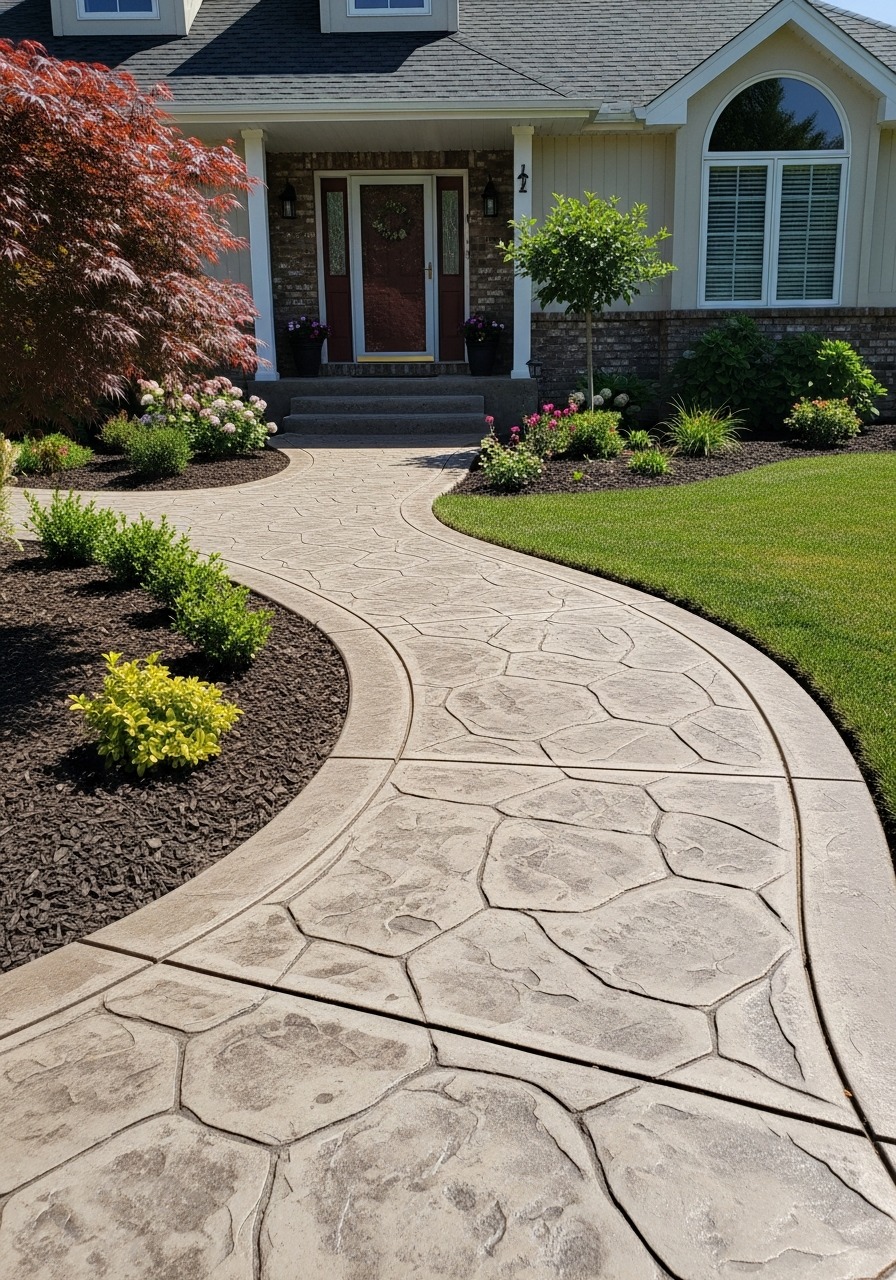
A gentle single arc (front door to driveway or street) is the most elegant and easiest to execute. A winding path with multiple direction changes works in larger gardens but requires more careful planning — too many turns and it reads as chaotic rather than designed. For a front walkway, a single gentle arc (curving 2–4 feet off the straight centerline over a 25–30 foot run) is the optimal choice: subtle enough that it reads as intentional rather than evasive, and dramatic enough to distinguish the path from a straight pour. For a rear garden or backyard path connecting a patio to a gate or outbuilding, a slightly more pronounced winding course is appropriate — especially if the path needs to navigate around planting beds or a lawn feature. A well-formed single arc front walkway costs $6–10/sq ft (plain) or $12–18/sq ft (stamped) — the curve adds 10–20% for forming but the total budget impact on a 120 sq ft walkway is $100–400.
Let Existing Landscaping Dictate the Curve
The best curved walkways appear to navigate around something — an existing tree, a garden bed, a specimen shrub. If you're designing the curve without a natural obstacle to route around, you'll need a strong landscape feature at the inside of the curve to make the geometry feel earned.
Forming Curved Concrete
Curved concrete walkways require flexible steel or plywood forms rather than standard lumber. This adds forming labor and material cost — expect to pay 10–20% more per square foot than a straight walkway of the same finish type. The concrete itself is identical; it's the formwork that changes. A radius greater than 8 feet is achievable with standard 1/4-inch plywood bent around stakes — narrower radii require flexible metal bender board or pre-curved steel form. Some contractors use a saw-cut technique on straight pours to simulate a curved edge, but a genuinely poured curved form holds its edge crispness better over time. If the driveway is also being poured in the same project, curving the walkway apron where it meets the driveway adds minimal extra cost and creates a cleaner, more intentional transition than a square butt joint.
Patterns That Suit Curves
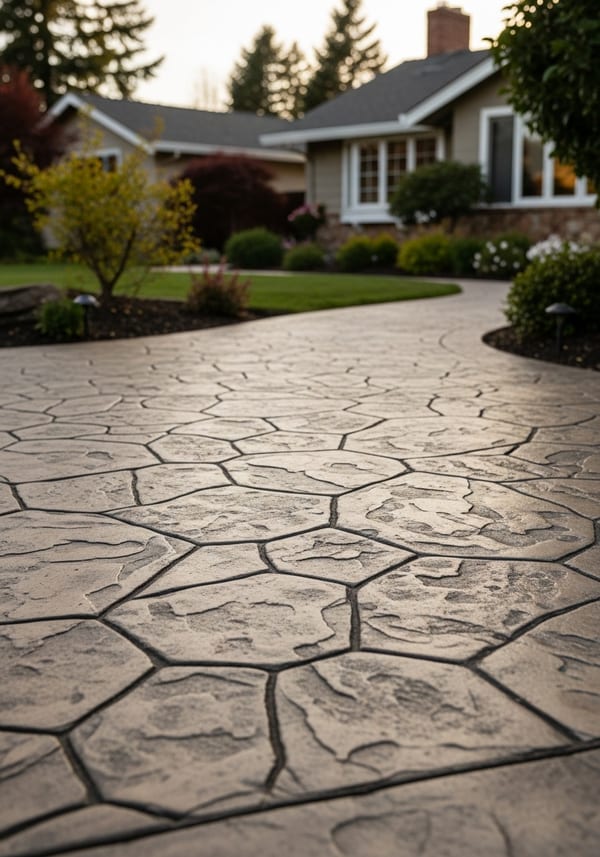
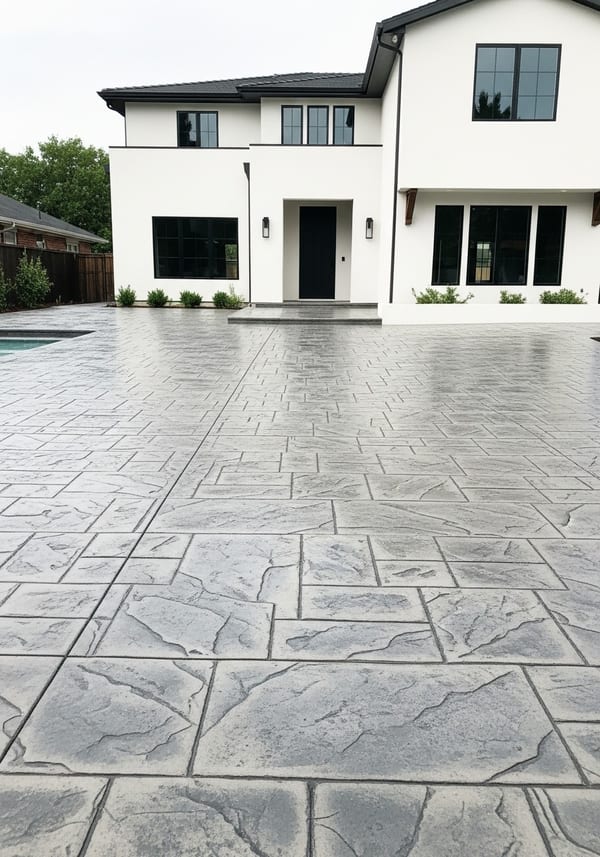
Random flagstone and organic patterns (irregular shapes, natural textures) suit curved walkways naturally. Geometric patterns like herringbone brick or linear planks fight the curve and can look awkward at the bends. If you want a geometric stamp, keep it a simple grid and accept that the pattern will cut at an angle at the edges.
Get the full inspiration pack — free.
30+ curated patio, driveway and walkway design images delivered to your inbox.
Edge Detailing
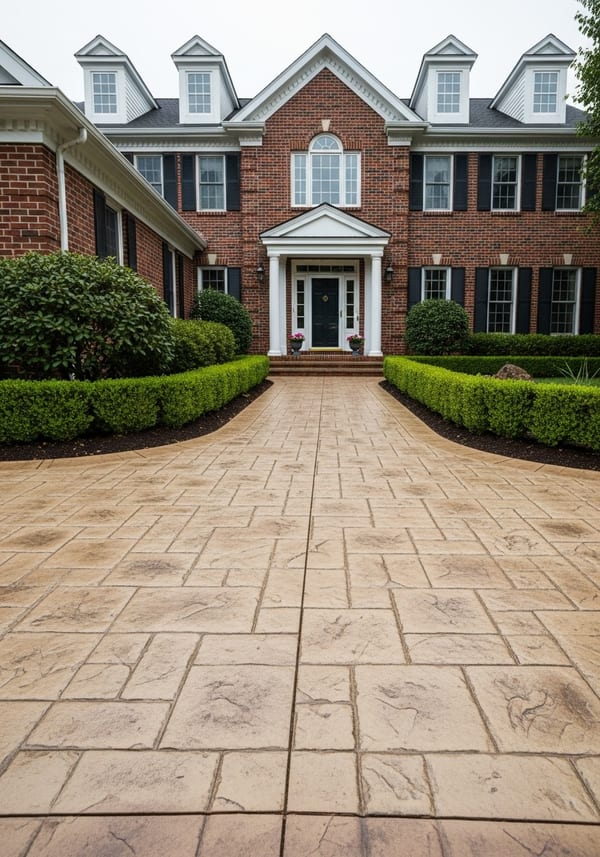
The outside edge of a curved walkway is where design attention pays off. A crisp, beveled edge with no metal edging showing reads as clean and intentional. Landscape boulders or low boxwood hedging along the outside of the curve reinforces the geometry and keeps the lawn from encroaching. The inside of the curve is the more complex design decision: leaving it open to the lawn requires the lawn to be kept neat to avoid the path looking unkempt; filling it with a garden bed eliminates the maintenance issue and gives you a planting opportunity that frames the path. A simple ground cover planting (ornamental grasses, low sedum, creeping junipers) at the inside of the curve is the standard landscape design move — it anchors the curve visually and eliminates the awkward triangular lawn corner that tends to grow unevenly. Budget $200–600 for a basic planting treatment at the inside of a curved front walkway if you don't already have established plants there.
Curved Concrete vs. Curved Pavers
Curved walkways are easier to execute in concrete than in pavers. Concrete forms can follow any curve — the material is poured and shaped. Paver installations require cutting individual units at the inside of the curve, which is labor-intensive and produces visible cut edges if not done carefully. Concrete with a flagstone stamp achieves the same natural, organic appearance as a paver path without the cutting labor. The total cost of a quality curved concrete walkway with stamped finish ($12–18/sq ft) is comparable to a paver installation ($14–22/sq ft), but concrete is lower-maintenance and structurally monolithic — individual pavers sink and shift; a poured path doesn't.
Designing Curves That Connect Front and Back
The most effective landscape walkway systems use a consistent curve vocabulary throughout the property — the front walk, side yard path, and backyard path share the same general radius and arc style. This doesn't mean every path looks the same; it means the outdoor hardscape reads as a unified plan rather than unrelated projects. If you're designing a front curved walkway, think at the property scale: where does the path system ultimately lead, and how do the curves of one surface flow visually into the next? For properties where the front walk, side yard, and patio are all connected, a contractor who plans all three surfaces simultaneously can create a cohesive flow that's much harder to achieve when each surface is designed independently.
Curved Walkways and Driveway Integration
A curved front walkway that terminates at the driveway — rather than at the street — is one of the most functional design choices for homes with front-facing garages. The walkway curves from the front door to the driveway, eliminating a separate path to the street while providing a clear, designed guest approach. This layout works particularly well when the driveway is also poured concrete: the walkway and driveway can be poured as a continuous surface with a score line or pattern border marking the transition. The shared pour saves mobilization cost and ensures the surfaces match in color and texture.
Cost to Add a Curve to an Existing Straight Walkway
If you have an existing straight concrete walkway and want to introduce a curve, the practical option is full demolition and replacement — you can't add a curve to a poured walkway without breaking out the existing slab. Demo of a standard front walkway runs $300–600 for a contractor; new curved pour adds the 10–20% forming premium on top of the base walkway cost. Alternatively, a concrete overlay with saw cuts and crack control joints can soften the appearance of a straight path, but it can't change the physical geometry. Budget the full replacement cost for any project where the goal is changing a straight walkway to a curved one.