Natural flagstone walkways cost $25–45 per sq ft installed. Stamped concrete mimicking the same look runs $12–18 per sq ft. On a 150 sq ft front walkway, that's a $2,000–4,000 difference. Both materials are legitimate choices — the right one depends on your budget, climate, and how much you care about long-term repairability. This comparison cuts through the landscaping marketing to give you a straight answer. The same cost and performance logic applies when comparing flagstone to concrete on a patio or driveway.
Cost Comparison
Natural flagstone walkways run $25–45 per sq ft installed. A stamped concrete walkway mimicking the same look costs $12–18 per sq ft. On a 150 sq ft front walkway, that's a $2,000–4,000 difference. Stamped concrete wins on cost for every project size — the gap doesn't narrow at scale.
Flagstone vs Concrete: Full Comparison
Side-by-side comparison across the factors that matter most for a walkway decision.
| Factor | Natural Flagstone | Stamped Concrete | Plain Broom-Finish Concrete |
|---|
| Cost per sq ft | $25–45 | $12–18 | $6–10 |
| Lifespan | 25–40 years | 25–40 years | 30–50 years |
| Annual maintenance cost | $150–300 (joint sand, re-leveling) | $50–150 (resealing) | $30–80 (resealing) |
| Freeze-thaw performance | Fair — joints crack, stones can fissure | Good — with air-entrainment | Good — with air-entrainment |
| Repair ease | Good — replace individual stones | Poor — color match is difficult | Fair — less visible on plain surface |
| Visual authenticity | High — natural texture and variation | Medium — convincing from street distance | Low — utilitarian look |
| Slip resistance when wet | Good — natural texture | Good — depends on stamp depth | Good — broom lines provide grip |
Maintenance Over Time
Flagstone requires annual joint sand replenishment to prevent weeds, and individual stones can sink or shift over time — re-leveling a sunken stone costs $80–200 per stone professionally. Concrete needs periodic resealing (every 2–3 years) but doesn't shift, has no joints to weed, and is easily cleaned with a pressure washer. Over a 10-year period, the maintenance labor difference strongly favors concrete. The one maintenance scenario where flagstone has an edge: if a single section is damaged (cracked stone, frost-heaved unit), it's replaced individually at $80–250 per stone. A cracked concrete walkway section requires saw-cutting and repour, and the new section rarely color-matches exactly — a visible repair on a decorative surface. In climates with moderate freeze-thaw activity, this repairability difference is real.
Freeze-Thaw Performance
Both handle freeze-thaw cycles, but concrete with proper sealing and air-entrainment performs better. Natural flagstone can crack along natural fissures under repeated freeze-thaw stress, and the mortar or polymeric joints between stones are vulnerable to freeze-thaw cycling — joints that crack let water in, which worsens with each winter. If you're in a region with hard winters (Zone 5 and colder), concrete is the more reliable long-term choice. A stamped concrete walkway with air-entrainment (specified at pour time; typically 5–7% air content for northern climates), a proper 4-inch gravel sub-base, and a quality penetrating sealer handles severe freeze-thaw conditions well. On a patio or driveway in the same climate, the same concrete specification applies.
Visual Authenticity
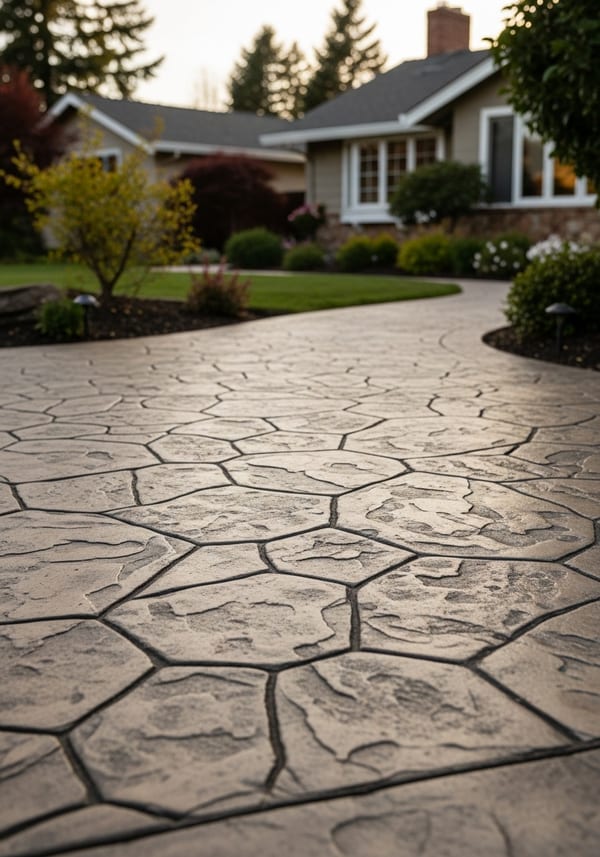
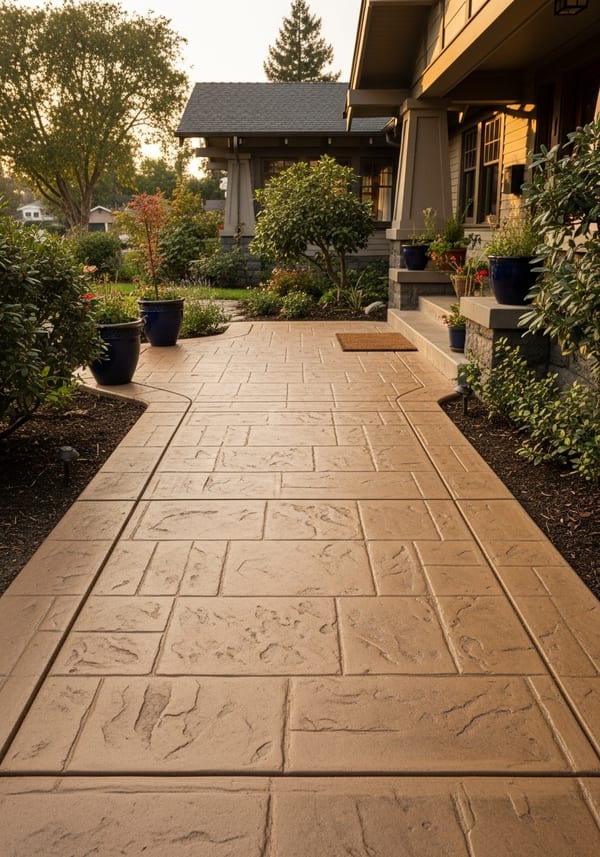
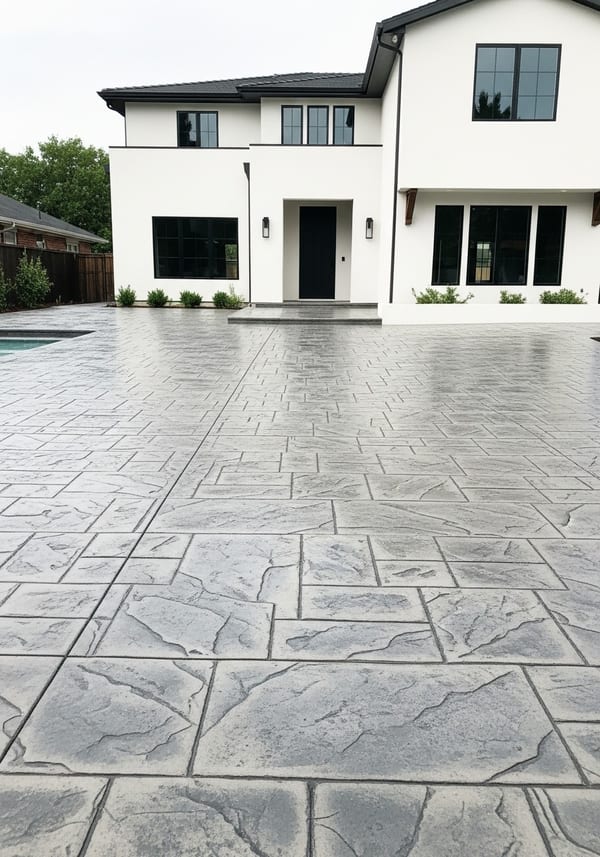
Up close, natural flagstone looks different from stamped concrete — there's a texture, irregular edge relief, and surface depth that stamping doesn't fully replicate. Each natural stone slab has its own character and thickness variation; stamped concrete, even with multi-layer color work, reads as a manufactured pattern at arm's length. From a street-view distance, well-done stamped concrete is nearly indistinguishable. The authenticity advantage matters most for high-end homes where buyers inspect closely, or for settings where visitors walk slowly and closely — a garden courtyard or rear terrace where people linger and look down. For a primary front walkway viewed from the street, the visual gap between high-quality stamped flagstone concrete and natural stone is minimal once color layering is done well.
Get the full inspiration pack — free.
30+ curated patio, driveway and walkway design images delivered to your inbox.
The Verdict
Stamped concrete is the right choice if budget matters, if you're in a cold climate, or if you want lower long-term maintenance. Natural flagstone is worth the premium for high-end homes where material authenticity affects resale value — but be honest about whether your home's price point supports a $4,000 upcharge on a walkway.
Concrete Walkway Maintenance vs. Flagstone Maintenance
Over a 10-year period, maintenance costs and effort favor concrete over natural flagstone. Stamped concrete requires resealing every 2–3 years ($0.50–2/sq ft DIY or professional) and occasional crack repair ($50–200 per crack, invisible if matched well). Natural flagstone requires annual joint sand replenishment ($0.10–0.25/sq ft in materials), occasional re-leveling of sunken stones ($150–300 per section), and weed management in the joints. Over 10 years on a 150 sq ft walkway, flagstone maintenance typically runs $1,500–3,000 in combined labor and materials; concrete maintenance runs $500–1,500. The cost gap further reinforces concrete's value advantage over natural stone.
Applying the Same Decision to a Patio or Driveway
The flagstone vs. concrete trade-off for a walkway is identical when applied to a patio or driveway — just scaled up. A flagstone patio runs $25–45/sq ft vs. $12–18/sq ft for stamped concrete; a flagstone driveway is impractical for most vehicles. The cost and maintenance comparison holds at every surface size. If you're deciding on materials for multiple outdoor surfaces simultaneously, stamped concrete wins on value at every scale unless authentic material texture is a hard requirement for the property's sale price. Tools like PourCanvas let you visualize different surface finishes — including flagstone-look stamped concrete — on your actual space before committing to a material and contractor.
Resale Value: Does Flagstone Add More Than Concrete?
Flagstone may add marginally more resale value than stamped concrete on homes at the top 10–15% of their local market — where buyers inspect closely and authenticity of materials matters to discerning purchasers. For the majority of homes, stamped concrete delivers similar visual impact at significantly lower cost, and buyers can't reliably distinguish the two from a normal viewing distance. Real estate appraisers generally don't distinguish between high-quality stamped concrete and natural stone for standard residential appraisals. The implication: spend the price premium on flagstone only if your specific home and buyer market demands material authenticity.
Regional Considerations for Walkway Material Choice
Climate affects the flagstone vs. concrete decision significantly. In freeze-thaw climates (Zone 6 and colder), concrete with proper air entrainment and sealing outperforms natural flagstone — freeze cycles stress the natural cleavage planes in stone and loosen mortar joints faster. In mild climates (Southwest, Pacific Coast), flagstone performs similarly to concrete over time and natural stone pricing is more competitive due to regional availability. In humid Southeast climates, both materials attract moss and biological growth — power washing and sealing are annual maintenance for either choice. Get quotes that reflect local labor rates: flagstone installation in New England can run $40–55/sq ft installed due to labor costs, making the stamped concrete premium narrower than in lower-cost markets.
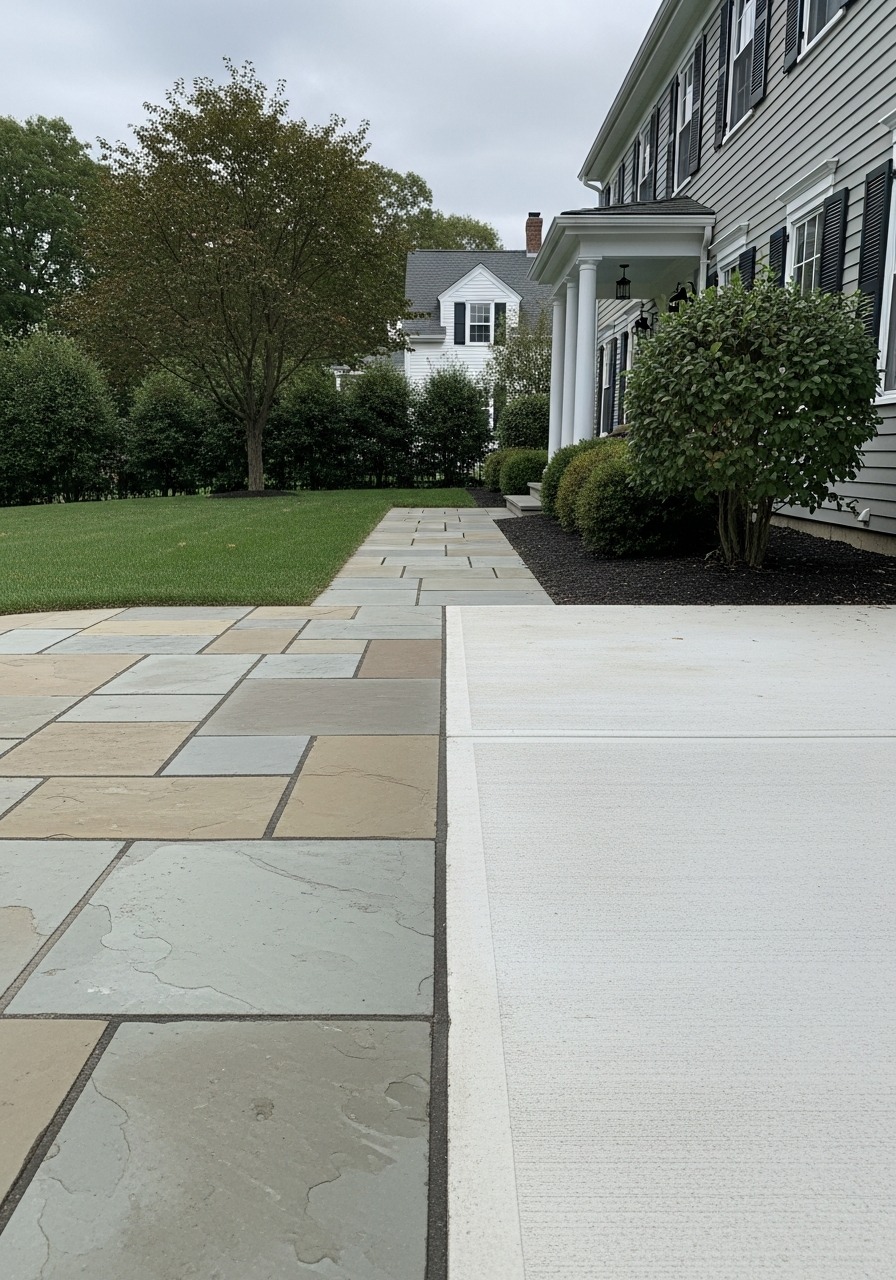
Transition Joints Between Flagstone and Concrete
Properties that mix flagstone and concrete — for example, a concrete driveway with a flagstone front walkway — need a well-designed transition joint at the point where the two materials meet. Without it, the different expansion rates of stone and concrete create stress cracking at the junction within 5–10 years. A properly specified expansion joint filled with a flexible backer rod and polyurethane caulk allows the two materials to move independently. This detail is often omitted on contractor bids — ask specifically about the transition joint treatment if you're mixing materials on the same project.