
Front Walkway Lighting Ideas That Actually Look Good
March 31, 2026
Path lighting for a standard 30-foot front walkway costs $150–600 in materials for a DIY solar or low-voltage system, or $500–2,000 for professional hardwired installation. Lighting is one of the highest-ROI curb appeal investments — it adds safety, extends usable evening hours, and changes how the entire exterior reads after dark. The choice of fixture style and placement matters more than budget. Here's what works and what tends to look cheap or dated.
Low-Voltage LED Path Lights: The Default for a Reason
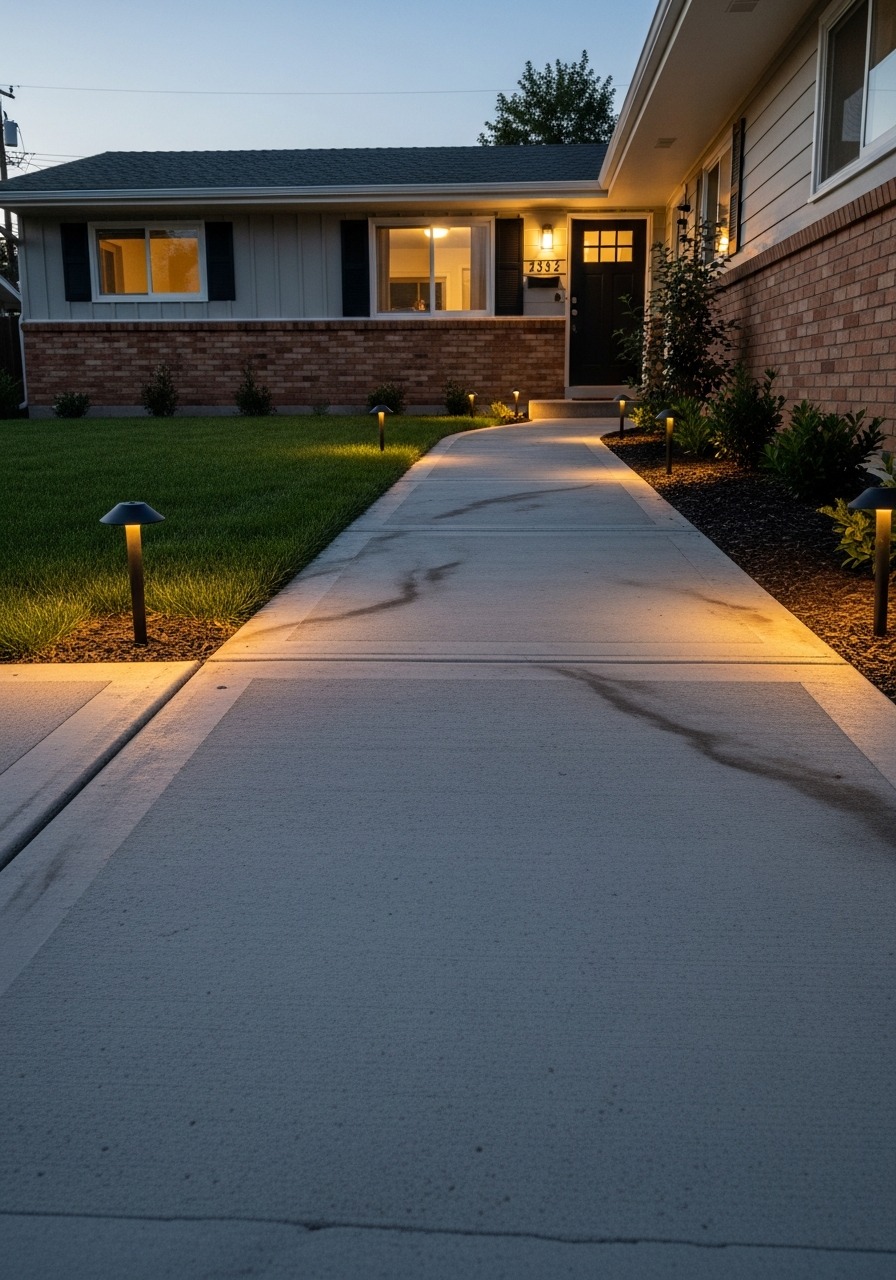
Low-voltage LED bollard-style path lights are the most popular choice — and genuinely the right call for most front walkways. A set of 6–8 lights on a 30-foot walk runs $80–300 in materials and connects to a transformer you plug into an outdoor outlet. Install time is 2–3 hours for a competent DIYer. Quality LED path lights (not the $8 solar units) last 10–15 years and maintain consistent brightness. Look for fixtures with a beam angle of 60 degrees or less — wider spread washes out the path and loses the layered look.
Solar vs. Low-Voltage: Which Is Worth It
Solar path lights cost less upfront ($20–80 for a set of 6) but have real limitations: inconsistent brightness, shorter runtime in winter or under tree canopy, and cheaper fixtures that look dated quickly. Low-voltage LED systems cost more upfront ($80–300 for comparable coverage) but provide consistent performance, year-round reliability, and look significantly cleaner — the wiring runs underground, not visible, and the fixtures are available in a much broader range of quality and style. For a primary front walkway visible from the street, low-voltage is the stronger investment. Solar is a reasonable choice for secondary garden paths where occasional dim nights are acceptable. The ROI calculation: a quality low-voltage system installed once at $500–1,000 for a front walk will outlast 3–4 generations of solar sets replaced at $30–80 each. The operational convenience of a system that works consistently — regardless of cloud cover, season, or canopy shade — is also worth accounting for. If the front walk is also the path to a driveway-facing garage, inconsistent lighting is a security concern.
Fixture Placement: The Rule That Changes the Result
Space path lights 6–8 feet apart on alternating sides of the walk — offset, not directly across from each other. Opposite-paired lights create a landing-strip effect that reads as institutional. Offset placement gives a more relaxed, residential quality. The top of the light should sit 12–18 inches above grade — low enough to light the path surface, high enough to not create tripping hazards or get obscured by plant growth. At a walkway-to-driveway junction, add a single fixture on each side of the transition — this marks the path entry from the driveway and guides visitors toward the front door rather than toward the garage. At the foot of entry steps, step lights in the risers replace path lights at that section — path lights aimed at a step riser from ground level create a glare spot; in-riser lighting evenly illuminates each tread from below. Planning the lighting zone changes before installation is the most common place homeowners save money: a single transformer can run the full path, step, and driveway edge circuit if the wire runs are planned before installation rather than retrofitted.
Uplighting: The High-Impact Upgrade
Adding 2–3 uplight fixtures aimed at a specimen tree or prominent shrub near the walkway changes the entire scale of the exterior after dark. Path lights alone light the ground; uplights create vertical dimension. The combination — low path lights along the walk plus one or two uplights on landscape features — is what separates a professionally designed exterior from a standard home improvement job. Budget $50–150 per uplight fixture for quality brass or powder-coated aluminum units that hold up outdoors.
Get the full inspiration pack — free.
30+ curated patio, driveway and walkway design images delivered to your inbox.
In-Ground Step Lighting
If your front walkway includes steps, in-ground or recessed step lights are the single most safety-critical lighting decision. A 3-step entry stoop with no riser lighting is a fall hazard after dark. Recessed LED step lights run $30–80 per fixture installed, or $150–400 for a typical 3-step entry. Wire them on the same transformer circuit as the path lights. Choose fixtures rated for wet locations and with a frosted lens — bare LED point sources on step risers are harsh and glare directly into visitors' eyes at approach angle.
Fixture Style: What Pairs with Your Surface Finish
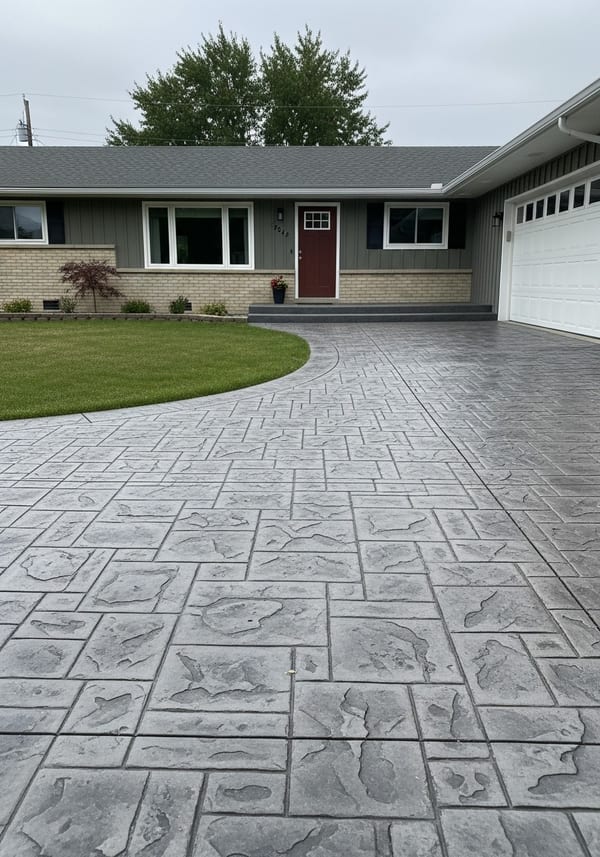
Warm brass or bronze fixtures pair naturally with stamped concrete in earth tones (buff, sandstone, aged brick colors). Matte black fixtures suit contemporary driveways with charcoal or dark grey concrete. Stainless or brushed nickel suits modern homes with cool-grey aggregate finishes. The lighting fixture style should reinforce the surface finish choice — if you're deciding on a walkway finish and want to add lighting, choosing the finish first makes the fixture selection easier. PourCanvas can help you visualize what your walkway surface will look like in different finishes before you commit to a material that may limit your fixture options.
Lighting the Full Property: Walkway, Driveway, and Patio
Walkway lighting works best as part of a coordinated exterior lighting system. A front path with path lights and step risers looks incomplete if the driveway is dark and the patio has no ambient light. A full exterior lighting plan typically includes: path lights along the front walkway (6–8 fixtures), driveway edge lighting or pillar lights at the entry ($150–600), patio string lights or mounted wall sconces ($200–800 installed), and uplights on 1–3 landscape features. The complete system for a standard residential property runs $1,000–3,500 installed, significantly less than the sum of three separate installations because one contractor handles the transformer, wiring runs, and fixture placement in a single mobilization.
Smart Lighting Integration
Smart outdoor lighting systems (Kichler, Lutron, CAST Lighting) allow scheduling, dimming, and zone control from a smartphone app. For a front walkway, a smart transformer ($80–200) can control the full path light circuit: set lights to turn on at sunset, dim to 20% after 11 PM, and turn off at sunrise automatically. The practical value on a front walkway is safety and energy management — lights that come on predictably without manual switches, and that dim overnight so they don't disturb neighbors or drain electricity through the early morning hours. The total smart lighting premium over a standard low-voltage system is $100–300 for most residential front walkway installations.
The AI tool is almost ready.
Drop your email and we'll notify you the moment it launches — free to use.