Staining is the most cost-effective visual transformation you can make to an existing concrete patio. Options range from a $1/sq ft water-based stain refresh on sound existing concrete all the way to a $14/sq ft full integral color pour with premium pigment loading — and everything in between lands a dramatically different patio for less than demolition and replacement would cost. Acid stain delivers mottled, organic color through a chemical reaction with the slab. Water-based stain offers a broader palette with more predictable coverage. Integral color mixes pigment into the pour itself for permanent, full-depth color that never chips away. This guide covers all three methods, the best colors for outdoor use in 2026, staining existing slabs vs. new pours, resealing schedules, and real cost comparisons against stamped and plain concrete.
Acid Stain: Natural, Mottled Color
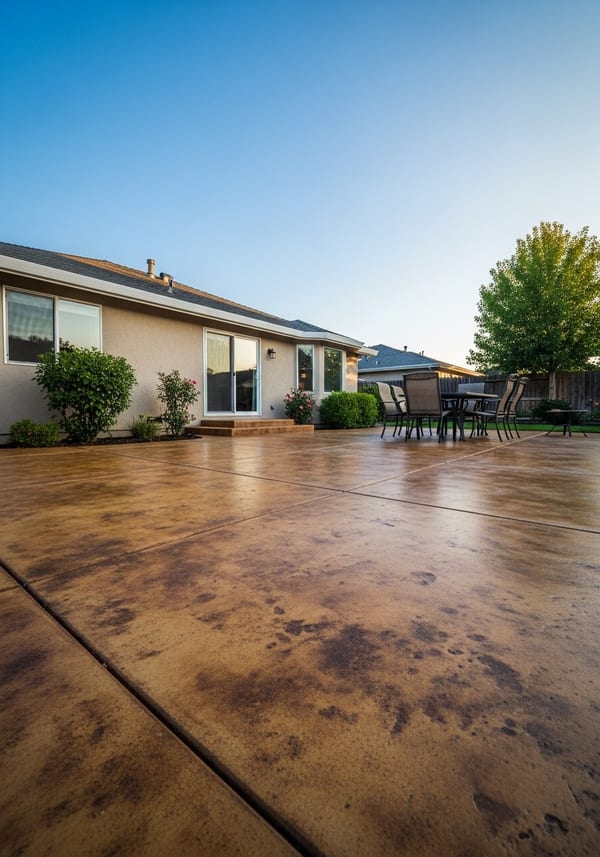
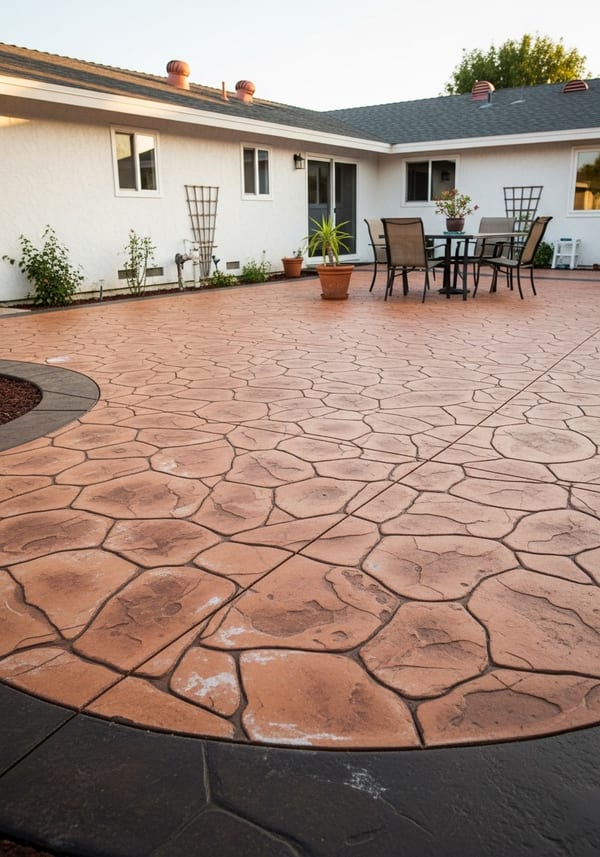
Acid stains react chemically with cured concrete to produce translucent, variegated color that penetrates the surface rather than sitting on top. No two applications look identical — the final result depends on the concrete's composition, age, porosity, and finishing texture. The most popular patio colors in acid stain are cola brown, desert amber, blue-grey, and verdigris green — all earth-derived tones that emerge from metallic salt reactions with calcium hydroxide in the slab. Cost runs $3-7/sq ft on existing concrete including stain, neutralization, and sealer application. The mottled, organic aesthetic suits Mediterranean, rustic, and transitional homes particularly well. Acid stain is the most artistic concrete color method available: you control the general direction but the concrete itself determines the final character. Heavily troweled areas absorb less stain and read lighter; broom-finished areas accept more and go deeper. This variation is a feature, not a flaw — it's what makes acid-stained concrete look like stone rather than paint.
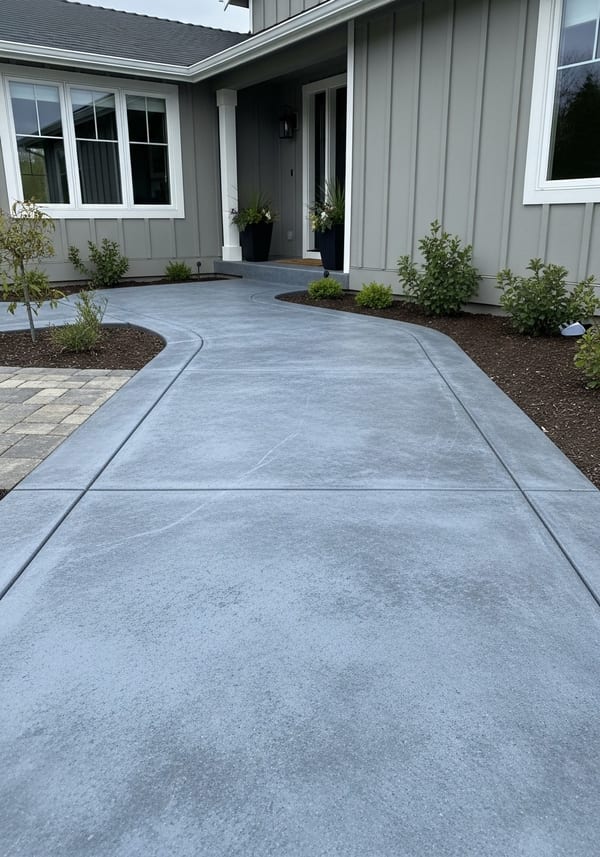
Water-based stains sit on top of the concrete surface rather than reacting chemically with it, delivering more predictable, opaque coverage with a color palette that extends far beyond what acid stain can achieve. Whites, true greys, deep blacks, blues, and custom-mixed tones are all available — colors that are chemically impossible with acid stain. Cost runs $2-5/sq ft on existing concrete including surface prep, stain, and sealer. The trade-off versus acid stain is depth: water-based stains produce flatter, more uniform color without the mottled variation that gives acid stain its character. For homeowners who want a specific color match to their exterior trim, furniture, or landscape palette, water-based stain delivers that precision. It can also be applied in patterns using stencils or tape for geometric designs — chevrons, borders, medallions, or tile-look grids — that acid stain's unpredictable absorption makes difficult. Water-based stain is the better choice when control matters more than organic character.
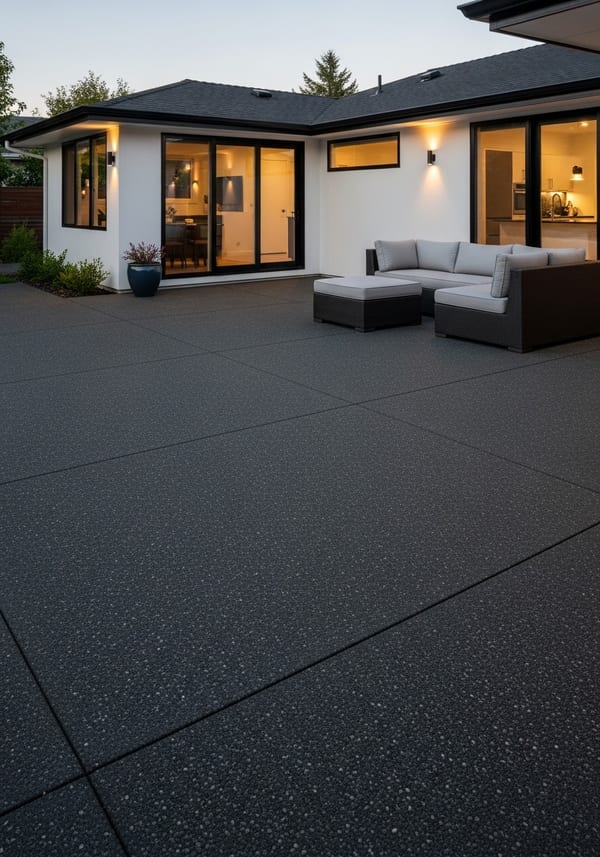
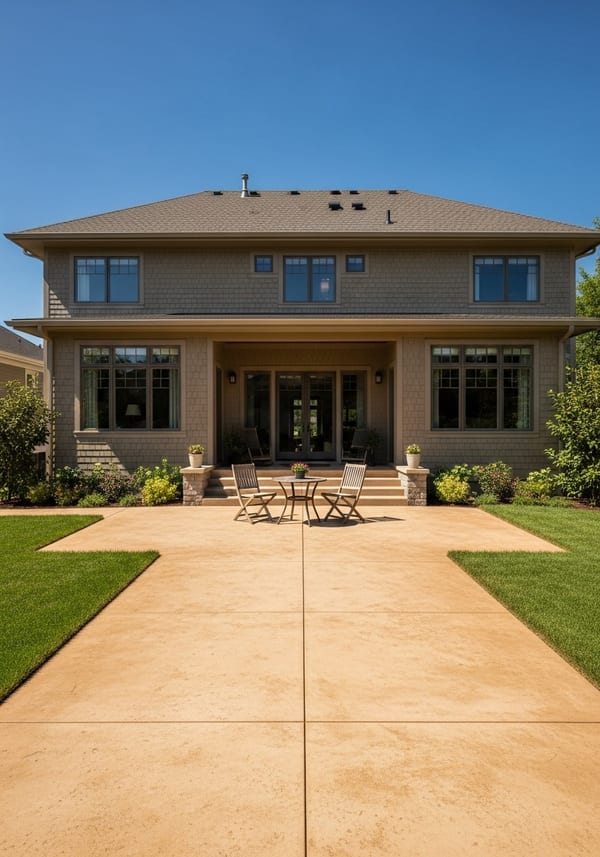
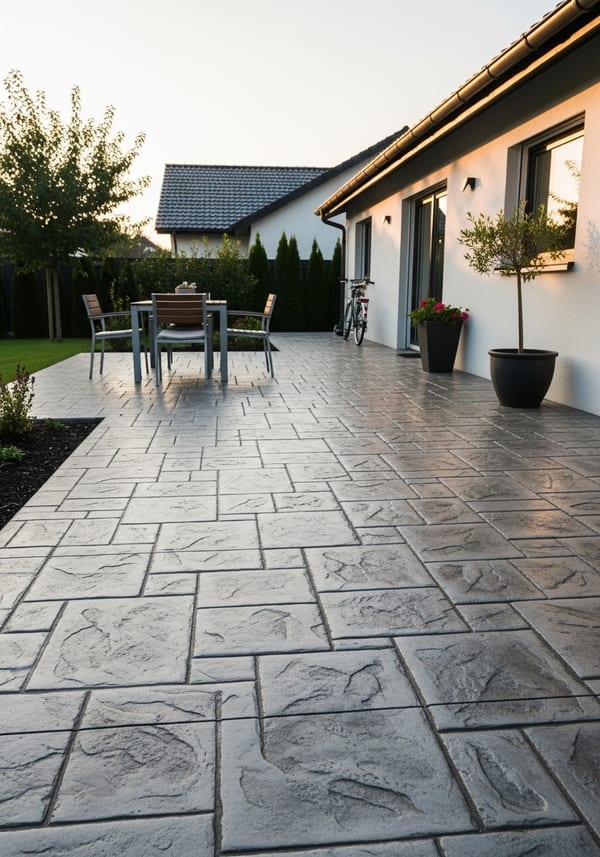
Integral pigment is mixed directly into wet concrete before pouring, coloring the entire slab through its full depth from surface to sub-base. Chips, abrasion, wear patterns, and surface damage never expose a different-colored layer beneath — the color is the concrete. This makes integral color the most durable coloring method available, though it requires a new pour (it cannot be added to existing slabs). Cost adds $2-4/sq ft to a standard pour depending on pigment density. The most popular integral colors for patios: charcoal at $2-3/sq ft additional (the most forgiving — hides dirt, complements everything), warm buff at $2-3/sq ft (traditional, pairs with brick and natural wood), and terracotta at $3-4/sq ft (requires heavier pigment loading to achieve saturation, hence the premium). Integral color works with any surface finish — broom, salt, exposed aggregate, or stamped — and the combination of integral color plus a complementary surface texture produces the richest-looking result in poured concrete.
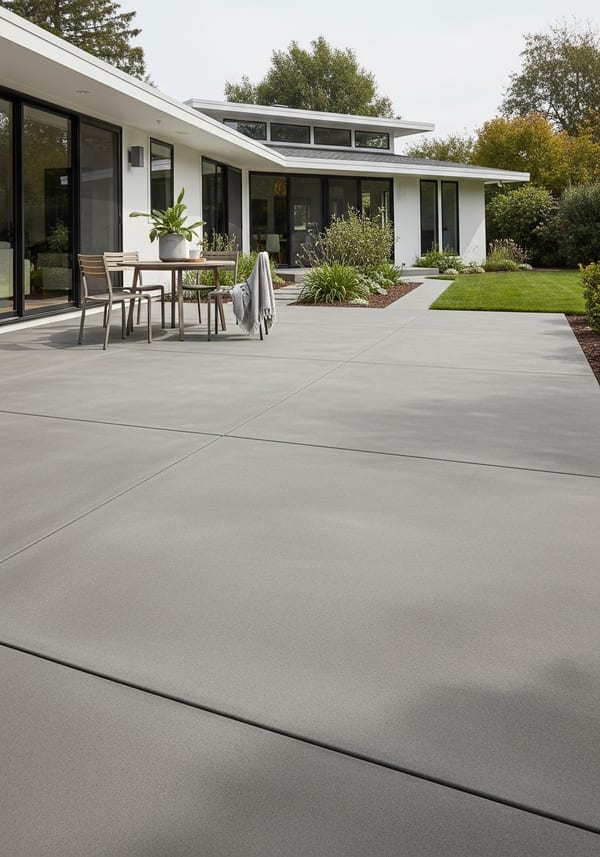
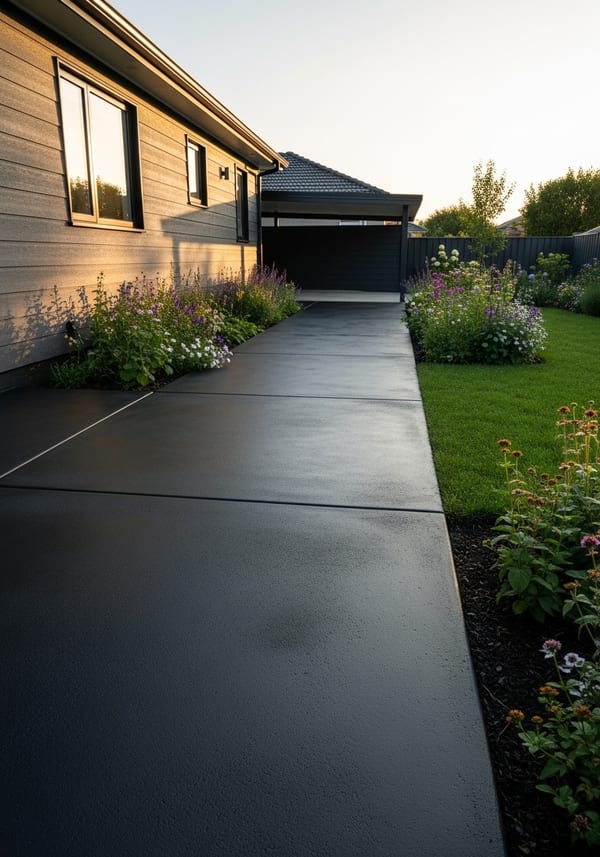
The colors with the longest visual shelf life on outdoor concrete: warm grey works with every architectural style, hides dirt and leaf stains, and photographs neutrally for listings — it's the safest choice when resale matters. Charcoal reads modern and dramatic, photographs exceptionally well, and makes outdoor furniture pop against the dark ground plane. Desert amber suits traditional homes with brick, natural wood, and warm-toned landscaping — it ages gracefully and develops more character over time rather than looking worn. Slate blue is the most distinctive contemporary choice — uncommon enough to stand out but neutral enough to avoid dating quickly; it does require UV-stable sealer commitment to prevent fading. Colors losing popularity: bright terracotta (too specific to one style, narrows resale appeal), concrete green (reads as a dated 2010s trend), and solid black (shows every leaf stain, water mark, and dust deposit — high maintenance for outdoor use).
Staining existing concrete ($3-7/sq ft) is the highest-ROI patio refresh available — it transforms the entire visual character of an outdoor space for $450-1,050 on a 150 sq ft patio versus $900-2,700 for demolition and full re-pour. Requirements for staining existing slabs: the concrete must be structurally sound with no major cracking or heaving, relatively level, and free of old sealers, paint, or coatings (stripping adds $1-3/sq ft). Heavily patched or repaired areas will accept stain differently than the surrounding concrete — always test a hidden corner or back edge before committing to full application. Concrete that has been previously acid-etched or muriatic-acid-cleaned may also react unpredictably. New pours with integral color ($8-14/sq ft total including the slab itself) cost more upfront but eliminate all surface preparation variables and deliver the most uniform, predictable result. The decision comes down to slab condition: if your existing concrete is sound, staining is the clear financial winner; if it's cracked, heaving, or heavily patched, a new integral-color pour provides better long-term value.
Maintenance and Resealing Schedule
Acid-stained patios need resealing every 2-3 years with a film-forming sealer (acrylic or polyurethane) at $1-3/sq ft professionally applied or $0.30-0.75/sq ft for DIY roller application. Water-based stains need resealing every 1-2 years because the stain bonds to the surface rather than penetrating it — a thinner connection that UV and foot traffic degrade faster. Integral color needs resealing every 3-5 years and a penetrating sealer is sufficient (no film-forming product required since the color can't wear off). UV-stable sealers add $0.50-1/sq ft over standard sealers but double effective color life on sun-exposed surfaces — they're worth the premium on south- and west-facing patios. Annual maintenance for all stained concrete: rinse with a garden hose, avoid pressure washing (strips sealer film and can mottle stain), and never apply de-icing salt (calcium chloride attacks sealers and can bleach acid stain). A well-maintained sealing schedule is the difference between stained concrete that looks rich at year 10 and stained concrete that looks neglected at year 3.
Cost Breakdown: Stained vs. Stamped vs. Plain
On a 300 sq ft patio, the full project costs break down as follows. Plain broom-finish new pour: $6-10/sq ft, total $1,800-3,000. Acid stain on existing concrete (no demolition): $3-7/sq ft, total $900-2,100. Integral color new pour: $8-14/sq ft, total $2,400-4,200. Stamped concrete new pour: $12-18/sq ft, total $3,600-5,400. Staining existing concrete is the only option in this list that doesn't require demolition of the current surface — making it the lowest total project cost when the existing slab is structurally sound. Even at the high end of stain pricing ($7/sq ft), the total ($2,100) undercuts the low end of a new plain pour ($1,800 plus $300-900 demolition of the old slab). For homeowners weighing a full patio redo versus a stain refresh, the math strongly favors staining unless the existing concrete has structural problems that compromise the surface.
How much does it cost to stain an existing concrete patio?
Acid staining an existing concrete patio costs $3-7/sq ft including labor, stain, and sealer. On a 200 sq ft patio, budget $600-1,400. If old sealers or coatings need stripping first, add $1-3/sq ft for surface prep. It's the lowest-cost major visual transformation available for any outdoor surface.
How long does stained concrete last outdoors?
Acid-stained concrete lasts 5-10 years between applications with proper resealing every 2-3 years. Integral color (pigment in the pour) is permanent — it doesn't fade because the color runs through the full slab depth. Water-based stains last 2-5 years depending on UV exposure and foot traffic. All stain types last longer in covered or partially shaded patios.
Can you stain old concrete that's already grey?
Yes. Acid stain works on any unsealed, uncoated cured concrete regardless of age. Older concrete often stains more attractively than new — the chemical variation that develops with age creates richer color mottling. The existing grey disappears under the stain color. Only problems: previously sealed or painted concrete needs stripping first, and heavily patched areas will accept stain differently.
Is acid stain or water-based stain better for a patio?
Acid stain produces more natural, organic color with mottled variation that's difficult to replicate — better for patios where character and visual depth matter. Water-based stain gives more predictable, uniform coverage and a wider color palette — better when you need to match a specific color or want consistent tone across the surface. For most patios, acid stain creates a more compelling result; for geometric or pattern work, water-based is more controllable.