

Stamped Concrete vs Pavers
Updated May 25, 2026
Stamped concrete costs $12–18 per sq ft installed. Pavers run $8–22 for concrete pavers and up to about $35 for clay brick, travertine or porcelain. On a 400 sq ft patio, that's $4,800–7,200 for stamped vs $3,200–8,800 for concrete pavers — similar money — and more for brick or stone. Cost favors stamped concrete against brick and stone, but the full ownership picture includes repair difficulty, long-term durability, climate performance, visual fidelity, and resale impact. Each factor shifts the calculus differently depending on your specific situation. This comparison covers all angles with real numbers so you can make the right call rather than the cheapest one.
Upfront Cost: Stamped Concrete Wins
Stamped concrete runs $12–18 per sq ft installed in 2026. Pavers cost $8–22 per sq ft for concrete pavers and up to about $35 for clay brick, travertine or porcelain, depending on material and pattern complexity. On a 400 sq ft patio, that translates to $4,800–7,200 for stamped concrete vs $3,200–8,800 for concrete pavers. Where pavers cost more, the gap comes down to labor intensity: stamped concrete is a single pour with pattern stamps pressed into wet concrete by a crew of 3–4 in one day. Pavers require individual piece setting — each unit hand-placed on a compacted sand bed, cut to fit edges, and swept with joint sand. That per-piece labor on a 400 sq ft patio means 800–1,200 individual pavers set by hand vs one continuous pour. The labor hours alone account for most of the price difference. Material cost matters too — concrete pavers themselves run $3–8 per sq ft wholesale vs $2–4 for the concrete mix in a stamped pour — but the labor gap is the primary driver.
10-Year Ownership Cost: Pavers Close the Gap
Stamped concrete requires resealing every 2–3 years at $1–3 per sq ft to maintain color depth and surface protection. On a 400 sq ft patio, that's $400–1,200 per application — roughly $1,600–4,800 over a decade assuming 4 resealing cycles. Add potential crack repair at $300–800 per occurrence if settling or freeze-thaw damage develops, and the 10-year stamped concrete total lands at roughly $6,500–10,000 including the initial install. Pavers need joint sand replacement every 3–5 years at $200–400 per application and occasional individual paver replacement at $5–15 per unit if one chips or settles. Brick or stone pavers remain more expensive over the ownership window, while basic concrete pavers can end the decade close to stamped concrete or below it. The longer you own the patio, the smaller the cost advantage of stamped concrete becomes.
Repair: The Biggest Difference
This is where pavers have their strongest advantage. A damaged paver can be pulled out with a flat pry bar, a matching replacement dropped in, and joint sand swept back into place — a 30-minute fix that costs $5–15 in materials and leaves zero visible evidence of the repair. Stamped concrete crack repair is a fundamentally different situation. Matching the existing pattern, color, texture, and wear level of a stamped surface is extremely difficult even for experienced contractors. The stamp impression must align perfectly with the surrounding pattern. The color must match concrete that has aged and weathered for years. The texture must blend with a surface that has been sealed multiple times. In practice, stamped concrete repairs are almost always visible — the patch reads as newer and slightly different from the surrounding area regardless of how skilled the repair contractor is. A cracked stamped patio is a harder, more expensive, and less satisfying fix than a cracked paver patio. If you live in a climate or on soil conditions where cracking is likely, this single factor may justify the paver premium.
Appearance: How Close Does Stamped Get?
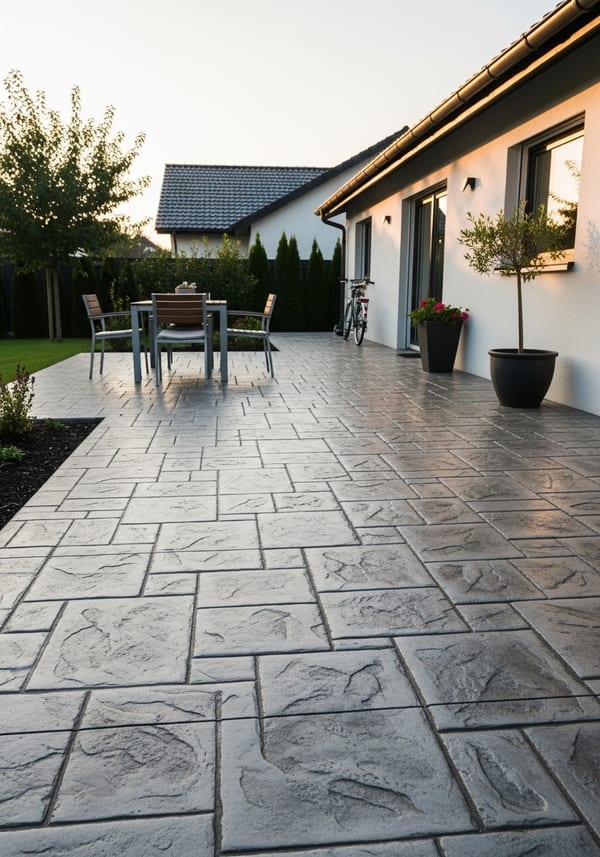
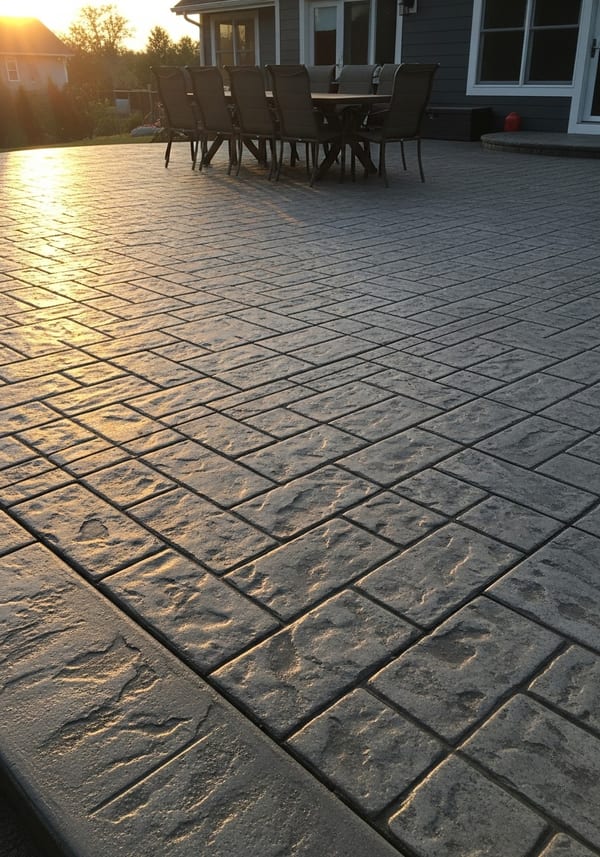
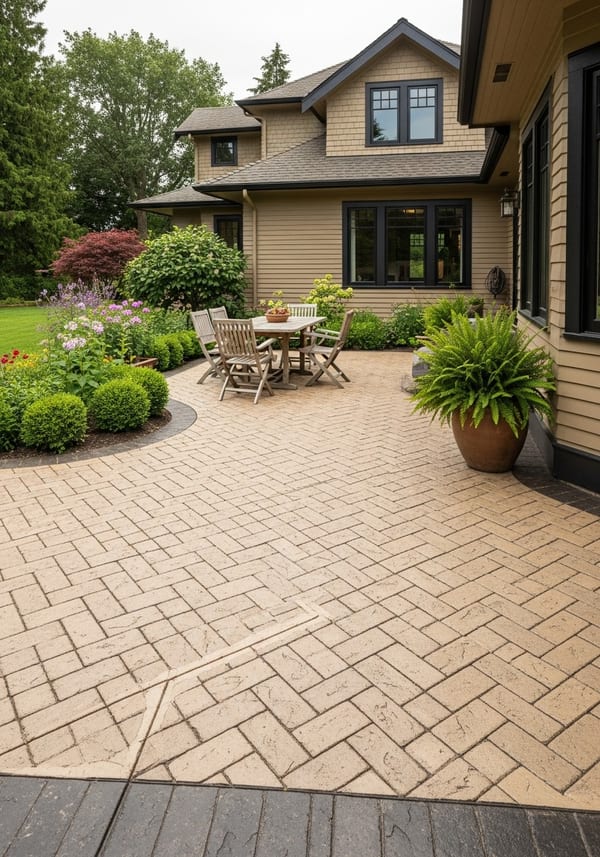
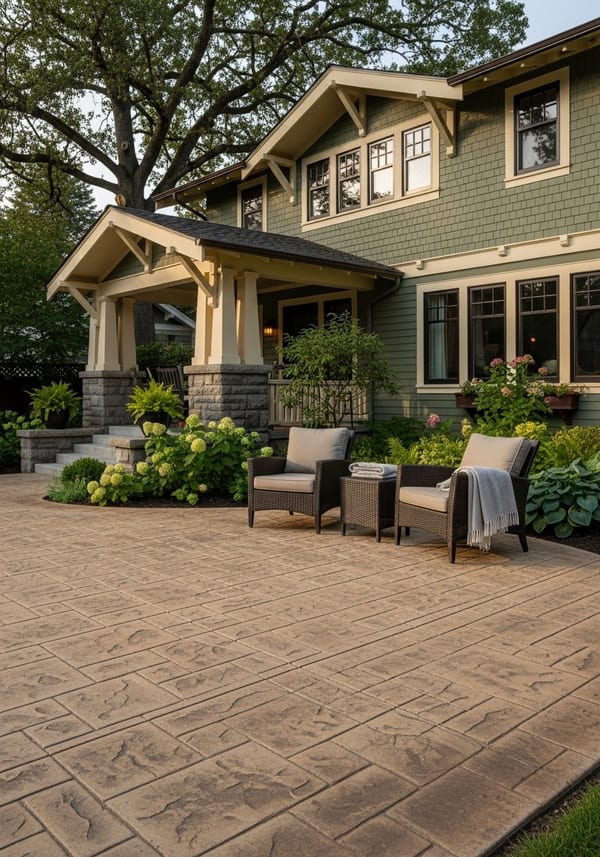
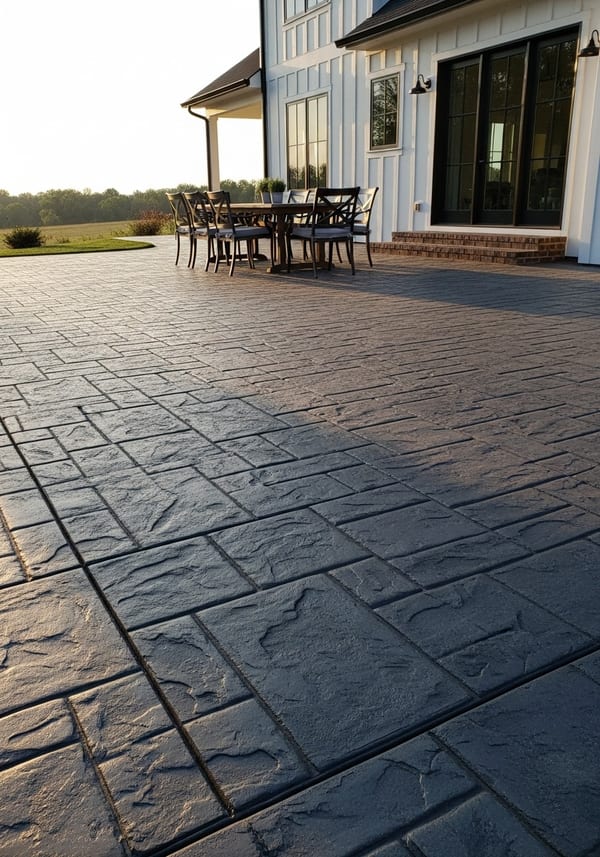
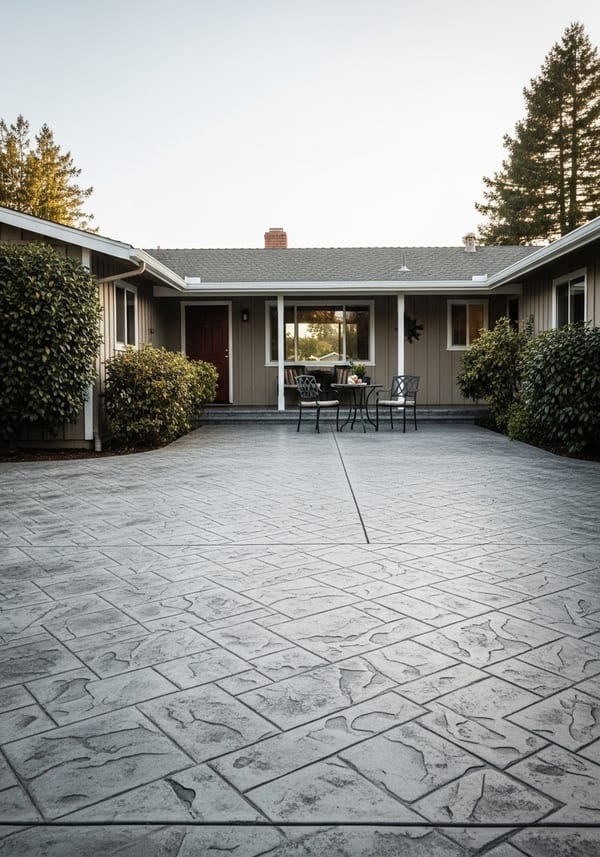
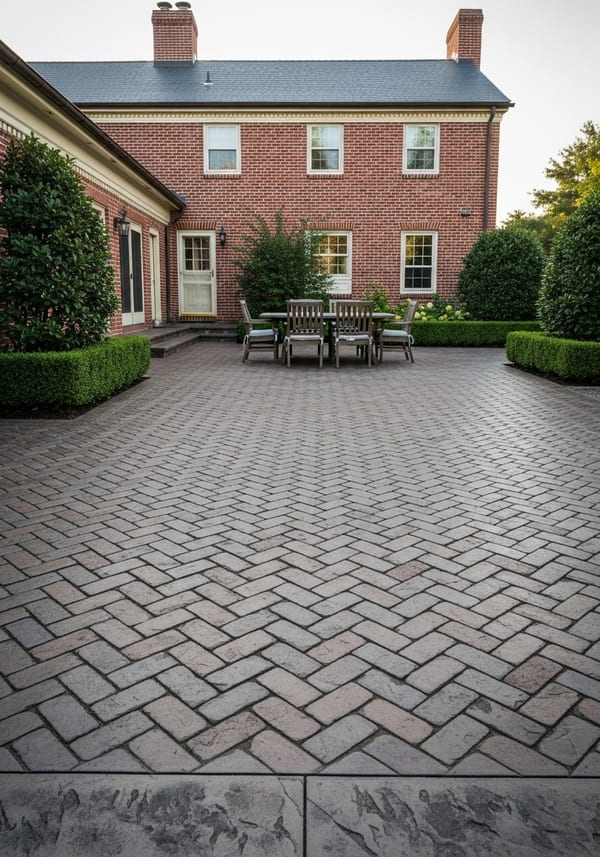
Modern stamped concrete replicates brick, stone, and slate patterns at 80–90% visual fidelity from normal viewing distance — standing height, 6+ feet away. A well-executed stamped patio with quality color layering is genuinely difficult to distinguish from real pavers in photographs and at conversational distance. Up close, the difference becomes apparent. Real pavers have genuine material depth — each unit is a separate physical object with its own slight color variation, edge wear, and surface texture. Sand-filled joints between pavers have a width and depth that stamped joint lines only simulate. The slight imperfections of individual manufactured or natural units create a visual richness that a continuous concrete surface approximates but cannot fully replicate. For specific patterns, stamped concrete is more convincing in some styles than others. Herringbone brick and cobblestone patterns are where stamped concrete is most successful — the regular geometry and uniform unit size play to stamped concrete's strengths. Natural flagstone with irregular thickness variation and organic edge shapes is where real stone retains a clear visual advantage over the stamped approximation.
Climate Performance: Freeze-Thaw and Heat
In freeze-thaw climates, pavers have a structural advantage. The joints between individual pavers act as expansion gaps — when the ground shifts with seasonal freeze-thaw cycling, the flexible joint system absorbs movement without cracking. Individual pavers may shift slightly but they don't fracture. Stamped concrete handles freeze-thaw stress at its control joints, but those joints are rigid cuts in a continuous slab. When movement exceeds what the control joints can handle, the slab cracks — and that crack is permanent and difficult to repair invisibly. Air-entrained concrete (with microscopic air bubbles mixed into the pour) mitigates freeze-thaw damage significantly but doesn't eliminate it entirely. In severe freeze-thaw markets — the upper Midwest, New England, and mountain regions — pavers' flexibility gives them a measurable durability advantage over any concrete surface. In hot, dry climates the picture reverses somewhat. Light-colored stamped concrete reflects solar radiation effectively and runs cooler than dark-colored pavers because the continuous slab has less thermal mass per unit of surface area. Neither material has a universal climate advantage — your specific region determines which performs better long-term.
Resale Value: What Buyers Actually See
Real estate agents consistently report that paver patios signal higher-end construction and carry a slight premium in buyer perception. Pavers read as a deliberate material investment — buyers associate them with custom landscaping and higher property values. However, the actual resale premium of pavers vs stamped concrete is smaller than the installation cost gap. A well-maintained stamped concrete patio in a neutral color (medium grey, charcoal, or warm buff) photographs beautifully for listings, shows well during walkthroughs, and doesn't meaningfully discount the property compared to pavers in the same price tier neighborhood. The scenario where pavers clearly win on resale: higher-end properties ($500K+) in markets where competing listings feature paver hardscaping as a standard expectation. In that context, stamped concrete can read as a cost-cutting decision. For mid-range properties where both options would represent a quality outdoor living upgrade, the difference in buyer response is marginal. The ROI gap between stamped concrete and pavers at resale is substantially smaller than the upfront cost gap — stamped concrete's cost savings are not fully erased by a lower resale premium.
The Verdict: Which to Choose by Scenario
Choose stamped concrete when: budget is the primary driver and you are comparing against brick or stone pavers; you're covering a large surface area where the per-sq-ft savings multiply significantly; you want a seamless, continuous look without joint lines; or you're in a warm, dry climate where freeze-thaw isn't a concern and light-colored concrete stays cool. Choose pavers when: individual repairability matters — you're on expansive soil or in a severe freeze-thaw climate where cracking is probable rather than possible; you value genuine material texture and depth over visual approximation; you're covering a smaller, high-visibility area where the cost premium is manageable in absolute dollars; you're building a pool surround where drainage between joints and thermal expansion tolerance matter; or you're building a high-end property where buyer expectations include real stone or brick hardscaping. For most homeowners in moderate climates with moderate budgets, stamped concrete delivers 85–90% of the visual result of brick or stone pavers at a lower cost. The 10–15% gap in appearance and the repairability disadvantage are real trade-offs — but for the majority of residential patios, stamped concrete is the stronger overall value.
Plan it with a free calculator
- Patio Cost CalculatorCompare installed patio cost across concrete, stamped, pavers, brick, stone and porcelain.
- Paver Patio Cost CalculatorInstalled cost, materials vs labor and a full material list for any paver patio.
- Paver Sand CalculatorBedding sand in tons, cubic yards and bags for any paver patio, walkway or driveway.
- Polymeric Sand Calculator50 lb bags of polymeric sand for any paver or flagstone area, by joint width, with cost.
Frequently Asked Questions
Is stamped concrete cheaper than pavers?
Usually, compared with brick or stone. Stamped concrete runs $12–18/sq ft installed vs $8–22 for concrete pavers and up to about $35 for clay brick, travertine or porcelain. On a 400 sq ft patio, stamped saves several thousand dollars over brick or stone but costs about the same as basic concrete pavers. The gap narrows over 10+ years due to resealing costs ($400–1,200 every 2–3 years).
Does stamped concrete crack more than pavers?
Stamped concrete can develop cracks along control joints, especially in freeze-thaw climates. Pavers don't crack in the same way — individual pavers can chip but the flexible joint system absorbs ground movement. For areas with significant freeze-thaw cycling, pavers have a durability advantage. Air-entrained concrete mitigates freeze-thaw damage but doesn't eliminate it entirely.
Can you tell the difference between stamped concrete and pavers?
At normal viewing distance (standing height, 6+ feet away), high-quality stamped concrete is difficult to distinguish from real pavers. Up close, pavers have genuine material depth, slight color variation per unit, and sand-filled joints that stamped concrete approximates but doesn't replicate. Herringbone brick and cobblestone patterns are where stamped is most convincing; irregular flagstone is where real stone retains a clear edge.
Which is better around a pool: stamped concrete or pavers?
Pavers have a slight edge for pool surrounds. The joints between pavers provide drainage, the individual pieces handle thermal expansion well, and a damaged paver near the pool can be replaced without touching the surrounding surface. However, stamped concrete with a non-slip finish and proper drainage slope works fine for most residential pools — the cost savings of $3,000–5,000 on a typical pool deck make it the more common choice.