

Patio Resurfacing Cost
Updated May 26, 2026
A concrete patio that's structurally sound but cosmetically tired has options short of full demolition. Resurfacing methods range from $3–10/sq ft depending on the technique, versus $8–18/sq ft for a complete tear-out and re-pour. On a 300 sq ft patio, that's the difference between a $900–3,000 refresh and a $2,400–5,400 replacement. The right method depends on what's wrong with the existing slab — cosmetic wear, minor cracks, or structural failure each point to a different solution and price tier.
Resurfacing vs Full Replacement: When Each Makes Sense
Resurfacing works when the existing slab is structurally sound — no major cracks running through the full depth, no heaving or settling that has shifted sections more than 1/4 inch relative to each other, and no active drainage problems causing ongoing damage. Cosmetic issues — surface spalling, discoloration, worn sealer, minor surface cracks under 1/8 inch — are all candidates for resurfacing. Full replacement is the right call when: cracks extend through the slab depth, sections have heaved or settled creating trip hazards, the sub-base has failed (evidenced by rocking or hollow-sounding sections), or tree roots have lifted portions of the slab. A contractor can assess slab condition in 15 minutes — the cost of a site visit ($0–150) is worth it before committing to a resurfacing method that won't hold on a compromised base.
Microtopping and Skim Coat ($3–6/sq ft)
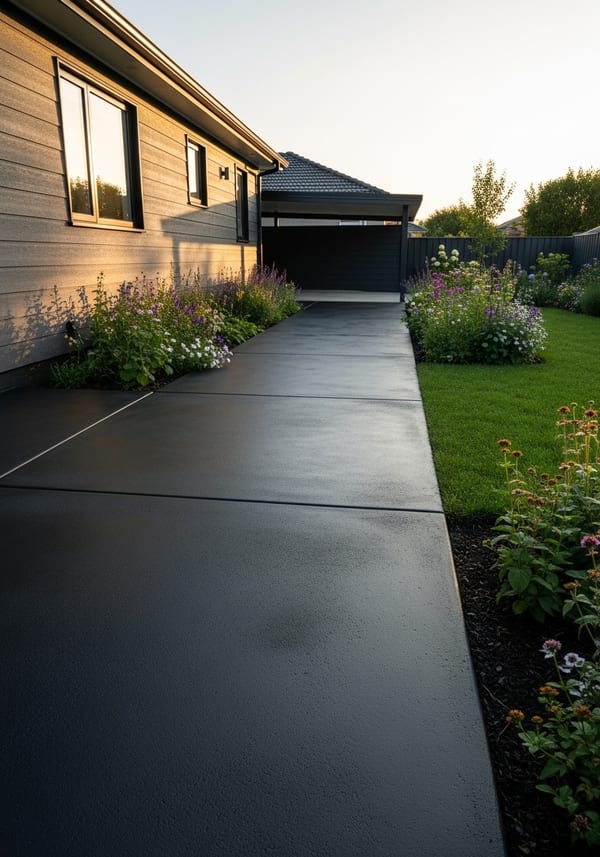
Microtoppings are the thinnest resurfacing option at 1/16 to 1/8 inch thick — a polymer-modified cement coating that bonds directly to the existing surface. At $3–6/sq ft installed, a 300 sq ft patio runs $900–1,800. Microtoppings create a smooth, fresh surface that can be integrally colored or stained after curing, but they're too thin to accept stamps or heavy texture. They cover surface discoloration, minor spalling, and cosmetic wear effectively. Lifespan is 5–10 years before recoating is needed, depending on traffic and weather exposure. The bond to the existing slab is the critical factor — proper surface prep (grinding, acid etching, or shot-blasting) is non-negotiable. A microtopping applied over a dirty or sealed surface delaminates within 1–2 seasons.
Stamped Overlay ($6–10/sq ft)
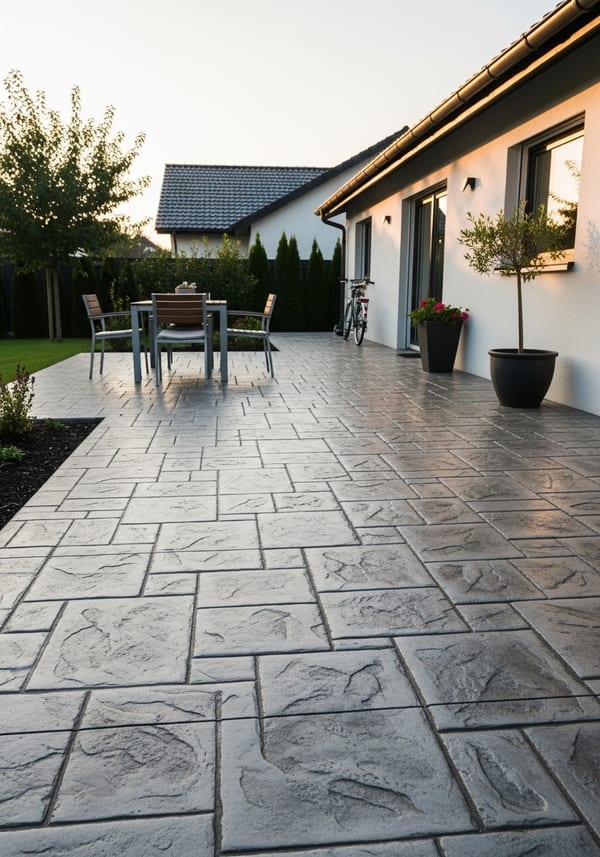
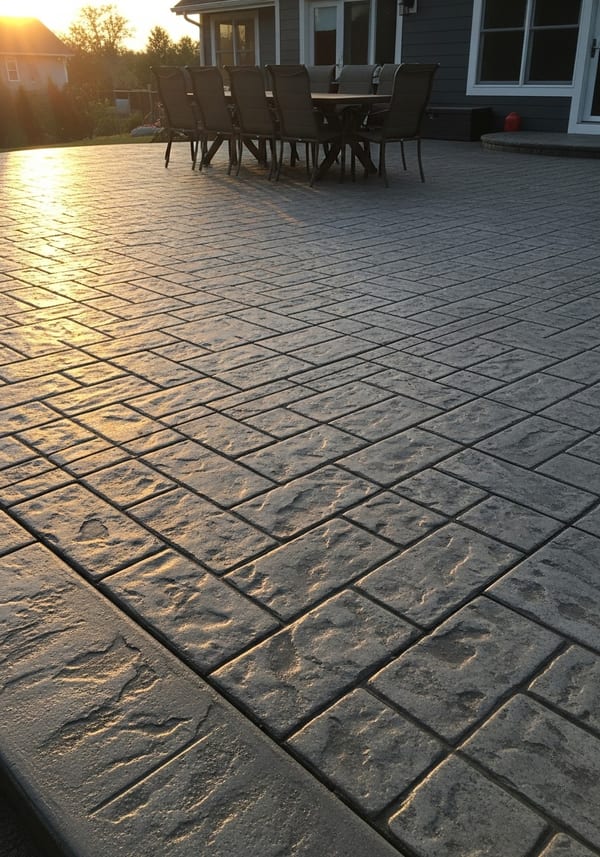
Stamped overlays are thicker than microtoppings — 1/4 to 1/2 inch — and can accept stamp patterns that replicate slate, stone, brick, or wood plank textures. At $6–10/sq ft installed, a 300 sq ft patio runs $1,800–3,000. This is the resurfacing method that delivers the most dramatic visual transformation: a plain grey slab becomes a stamped stone patio without demolition. The overlay bonds mechanically and chemically to the existing surface through primer and the overlay material itself. Durability depends almost entirely on that bond — a properly prepped and primed surface holds 10–15 years; a poorly bonded overlay can lift in sections within 2–3 years. Stamped overlays require the same sealing maintenance as new stamped concrete: every 2–3 years with a film-forming acrylic sealer.
Staining Existing Concrete ($3–7/sq ft)
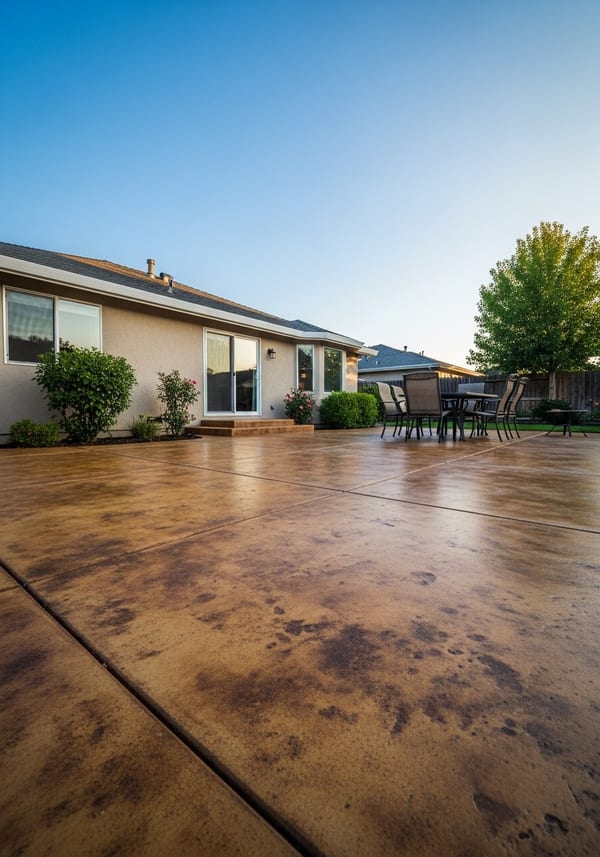
Staining doesn't add thickness — it changes only the color of the existing surface. Acid stain ($3–5/sq ft) chemically reacts with the concrete to produce translucent, mottled earth tones with a natural, organic quality. Water-based stain ($3–7/sq ft) sits on the surface and offers a wider color palette with more predictable, uniform coverage. On a 300 sq ft patio, staining runs $900–2,100 installed. It's the lowest-cost resurfacing option with the highest visual impact per dollar spent — but it requires a structurally sound, unsealed surface. Existing sealers must be stripped first ($1–3/sq ft additional). Staining works best on concrete that's in good structural condition but simply looks tired or dated. It won't hide cracks, spalling, or surface damage — it makes them more visible by adding color contrast.
Full Replacement Cost ($8–18/sq ft Including Demo)
When the existing slab has failed structurally, resurfacing is a temporary fix at best. Full replacement — demolition of the old slab plus a new pour — costs $8–18/sq ft depending on finish. Demolition and disposal add $2–6/sq ft to the new-pour price. On a 300 sq ft patio, total replacement runs $2,400–5,400. The advantage: a new pour gives you full freedom on finish, pattern, color, and thickness. You get a fresh sub-base preparation, proper drainage grading, and a slab that starts its 25–30 year lifespan from zero. Full replacement is also the right call when the existing slab was poured too thin (under 4 inches), on inadequate base material, or without proper control joints — resurfacing those slabs delays failure rather than preventing it.
DIY vs Contractor for Each Method
Microtopping is a moderate DIY project — the materials are available at concrete supply houses, application is with a squeegee and trowel, and the learning curve is manageable on a small surface. Budget $1–2/sq ft in materials for DIY versus $3–6/sq ft installed. Stamped overlays are not a DIY project — the stamping window is tight (15–30 minutes), stamp alignment requires experience, and a failed stamp attempt on an overlay can't be easily redone. Staining is a good DIY candidate — acid stain application with a pump sprayer is straightforward, and mistakes blend into the natural mottled pattern. Budget $0.50–1.50/sq ft in materials. Full replacement is not a DIY project — forming, pouring, finishing, and curing a concrete slab requires equipment, experience, and timing that are beyond typical homeowner capability. The cost of a failed DIY pour (demolition plus a contractor re-pour) exceeds the savings.
How to Get Accurate Quotes
Get a minimum of 3 quotes for any resurfacing project over $1,000. Each quote should itemize: surface preparation (grinding, etching, or shot-blasting), primer or bonding agent, overlay or stain material and thickness, sealer application, and cleanup. Ask whether the quote includes moving furniture and covering adjacent surfaces. Seasonal timing matters — fall quotes run 10–20% lower than spring in most markets because contractor demand drops after peak season. Bundling a patio resurface with driveway or walkway work from the same contractor typically saves 10–15% on mobilization costs. If multiple contractors recommend full replacement over resurfacing, the slab condition is likely worse than a visual inspection suggests — don't push for a cheaper resurfacing option when the professionals are telling you the base has failed.
Plan it with a free calculator
- Paver Patio Cost CalculatorInstalled cost, materials vs labor and a full material list for any paver patio.
- Patio Cost CalculatorCompare installed patio cost across concrete, stamped, pavers, brick, stone and porcelain.
- Paver CalculatorHow many pavers you need, plus base gravel, bedding sand, joint sand and edging for any size.
- Concrete Finish SelectorRank 7 outdoor concrete finishes for your surface, climate, priority and style.
Frequently Asked Questions
How much does it cost to resurface a 300 sq ft patio?
A 300 sq ft patio resurface costs $900–1,800 for a microtopping, $1,800–3,000 for a stamped overlay, or $900–2,100 for staining. Full replacement with demolition runs $2,400–5,400. The right method depends on the condition of the existing slab — cosmetic damage calls for resurfacing; structural failure requires replacement.
Is it cheaper to resurface or replace a concrete patio?
Resurfacing is significantly cheaper: $3–10/sq ft versus $8–18/sq ft for full replacement including demolition. On a 300 sq ft patio, resurfacing saves $1,500–2,400 minimum. But resurfacing only works on structurally sound slabs — if the base has failed, resurfacing delays the problem rather than solving it.
How long does a concrete patio overlay last?
A properly bonded stamped overlay lasts 10–15 years with regular sealing every 2–3 years. Microtoppings last 5–10 years. Both depend heavily on surface preparation quality — the bond to the existing slab is the single biggest factor in overlay longevity. A failed bond causes delamination within 1–3 years.
Can you resurface a cracked concrete patio?
Minor surface cracks under 1/8 inch can be filled and resurfaced successfully. Cracks that extend through the full slab depth, or sections that have shifted or heaved, indicate structural failure — resurfacing over those areas creates a temporary cosmetic fix that fails within 1–3 years. Full replacement is the right call for structurally compromised slabs.