

Black Stamped Concrete for Driveways and Patios: Colors, Patterns and Cost
October 10, 2026
Black stamped concrete is a dark base color pressed with a stone or slate pattern, usually with a dark release powder in the joints. As of 2026, stamped concrete runs $8–28 per sq ft installed, or $2,400–8,400 for a 300 sq ft patio. Most "black" stamped work is really charcoal, because a dark release over a lighter base shows the pattern.
How Stamped Concrete Gets a Black or Charcoal Look
Stamped concrete gets its color in two layers. The base color goes into or onto the slab, either as integral color mixed into the concrete or as a color hardener worked into the surface. The release is a powder dusted on just before stamping. It stops the stamp from sticking and, after washing, leaves a second color in the texture (Butterfield Color). Brickform describes its Antique Release as a hydrophobic powder that adds color while acting as a bond breaker (Brickform).
That two-layer system is why pure black is rare. Butterfield's pattern guide advises that "darker release agents over lighter base colors work best" (Butterfield pattern guide). A black base with a black release gives you a flat, dark slab where the pattern is hard to read. A grey or slate base with a deep charcoal release reads as black from a distance and still shows the stone. Brickform lists Carbon Black integral color, Dark Gray color hardener, and Dark Gray and Black release as its charcoal-and-black options. It notes these darker shades work well as accents or borders (Brickform).
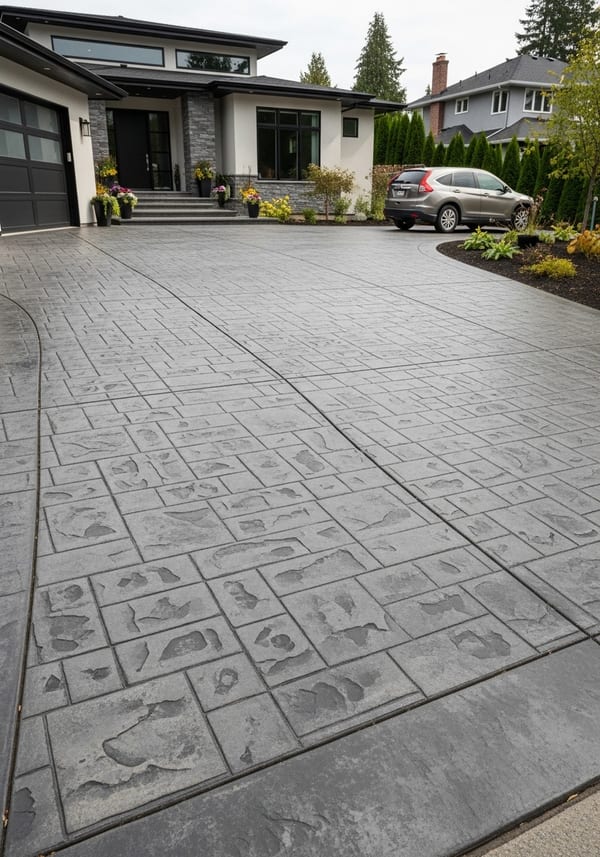
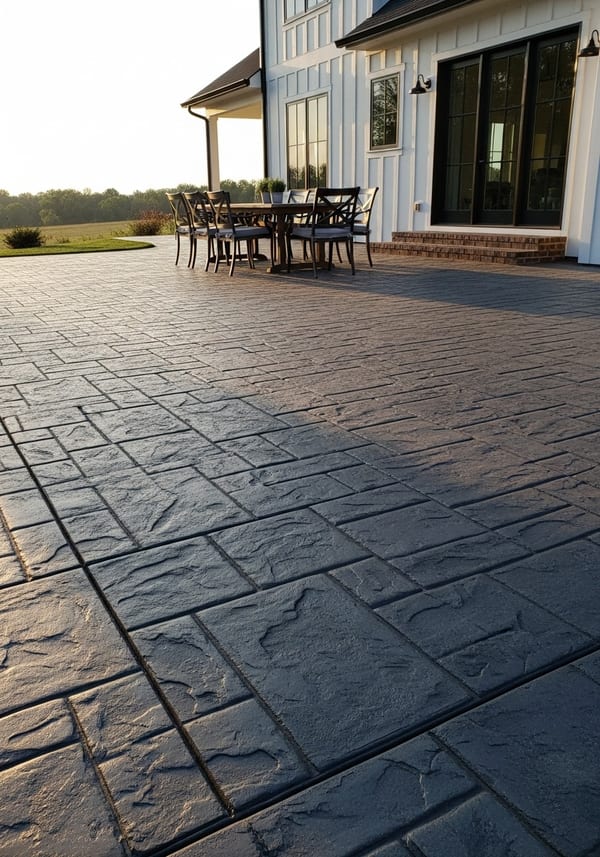
Base and Release Color Pairings for Black Stamped Concrete
These pairings come straight from manufacturer pattern guides. Codes are Butterfield integral (U), hardener (P) and release (R) colors, and Brickform products.
| Pattern | Base color | Release color | Result | Source |
|---|---|---|---|---|
| 3' x 3' Slate | U18 Gull Gray | R13 Deep Charcoal | Light grey stone, near-black joints | Butterfield |
| 18" x 36" Bluestone | P28 Slate Gray | R13 Deep Charcoal | Dark blue-grey, charcoal texture | Butterfield |
| Verona Cobblestone | U13 Millstone | R13 Deep Charcoal | Grey cobbles, dark joints | Butterfield |
| Granite Herringbone | U13 Millstone | R13 Deep Charcoal | Grey stone, dark joints | Butterfield |
| Majestic Ashlar | U35 Shadow Slate | R28 Slate Gray | Dark slate overall | Butterfield |
| Ashlar Slate | U14 Pewter | R12 Storm Gray | Mid-dark grey slate | Butterfield |
| Bluestone texture | Slate integral color | Dark Gray Antique Release | Dark blue-grey slate | Brickform |
| Any pattern, darkest option | Carbon Black integral color | Black or Dark Gray release | Near-solid black | Brickform |
Sources: Butterfield pattern selection guide, Brickform color combinations. Butterfield's dark releases include Deep Charcoal, Storm Gray, Slate Gray, Smoke and Cape Cod Gray, and it warns not to choose colors from a computer screen (Butterfield Color). Ask your contractor for a sample panel. If you go with the Carbon Black integral, read the fading caveat below first.
Stamped Patterns That Look Best in Black
Dark colors flatten detail, so patterns with deep, irregular texture and clear joints hold up best in black or charcoal.
| Pattern | How it reads dark | Best for |
|---|---|---|
| Ashlar slate | Rectangles of varied size; the slate skin catches the release | Driveways and patios, modern to transitional |
| Slate texture (seamless) | No joints, just stone texture; very calm in charcoal | Modern patios, pool surrounds in mild climates |
| Cobblestone | Deep joints carry the dark release; reads as old-world stone | Traditional driveways, courtyards |
| Bluestone / large slab | Big units, clean lines; strong with charcoal joints | Contemporary driveways and patios |
| Wood plank | Grain is lost in solid black; works in charcoal with lighter base | Patios and decks only |
For every pattern and its cost, see our stamped concrete patterns guide and the stamped concrete material page.
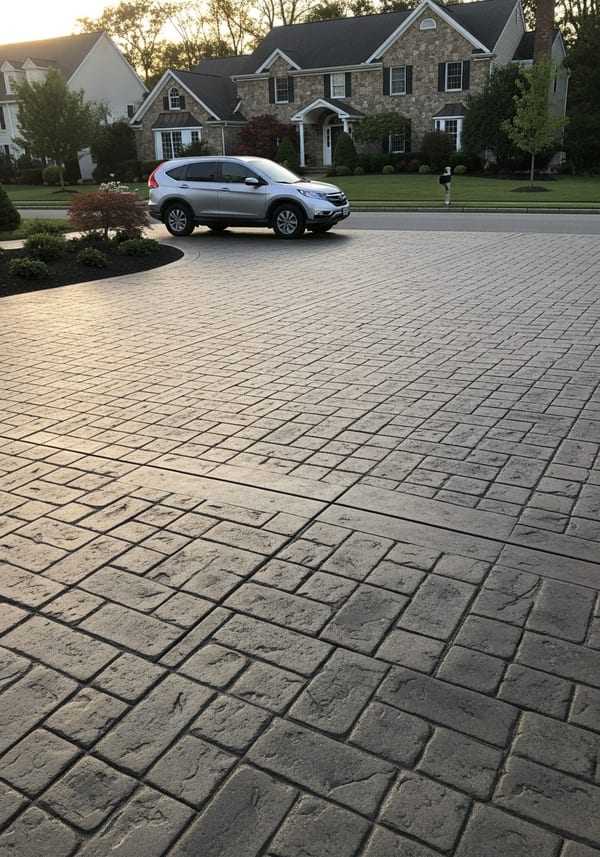
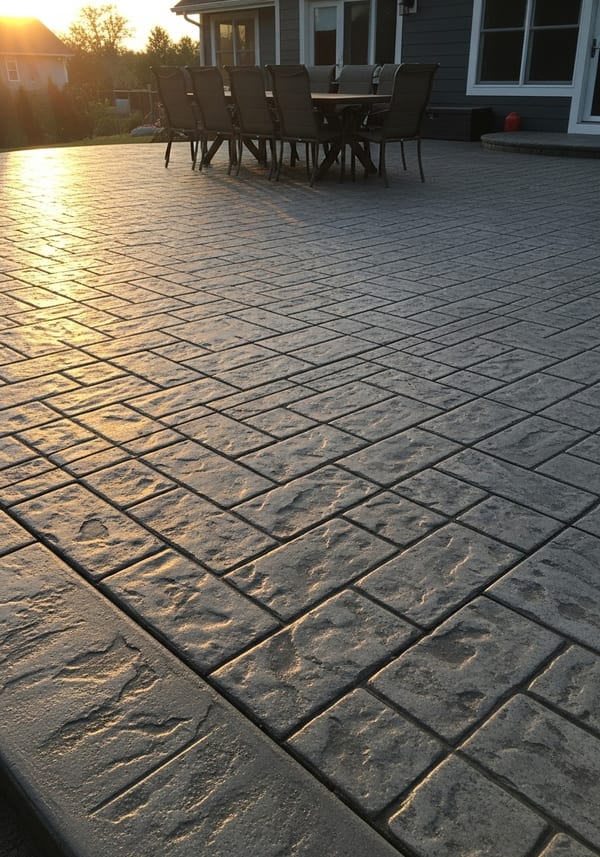
Black Stamped Concrete Driveway vs Patio
The same color behaves differently under cars and under bare feet.
| Factor | Driveway | Patio |
|---|---|---|
| Main wear | Hot and turning tires, deicing salts | Foot traffic, furniture, sun |
| Sealer stress | High; hot tires can damage sealer | Moderate |
| Heat concern | Minor (vehicles) | Major (bare feet, pets) |
| Best pattern | Ashlar slate, cobblestone, bluestone | Ashlar slate, slate texture |
| Best shade | Charcoal with dark release | Lighter base with charcoal release |
Butterfield notes that hot car tires, or turning tires while a car is standing, may damage the sealer, and that surfaces exposed to car traffic or deicing salts wear faster (Butterfield Color). On a patio, heat matters more: Brickform notes that white stamped concrete stays cooler than dark colors because it reflects heat (Brickform). For a driveway built around a solid dark slab instead of a pattern, see our black concrete driveway guide and stamped concrete driveway ideas.
Heat and Fade Caveats for Black Stamped Concrete
Heat. The EPA reports that conventional concrete and asphalt can reach peak summer surface temperatures of 120–150°F. LBNL researchers estimated that every 10 percent increase in solar reflectance lowers surface temperature by about 7°F (EPA Cool Pavements Compendium). New grey concrete reflects 30–50% of sunlight and new asphalt about 5% (LBNL Heat Island Group). A black stamped patio moves toward the asphalt end of that scale. In hot climates, keep black stamping to driveways or shaded areas, or use a lighter base with a charcoal release.
Fade. The pigment decides how the color ages. LANXESS calls its iron oxides weather- and light-stable, and found that carbon-black paving stones faded in a maritime climate while iron-oxide-black ones did not (LANXESS). Carbon black can leach out of exterior concrete (Concrete Decor), and Solomon recommends keeping carbon-black concrete sealed (Solomon Colors). Release color is more forgiving: Butterfield says its Perma-Cast release color is permanently embedded in the textured surface (Butterfield Color).
Sealer for Black Stamped Concrete
Sealer is what makes black stamped concrete look black. Solomon's color card notes that its chips show unsealed concrete and that a sealer may darken the color (Solomon Colors). Most decorative acrylic sealers last two to three years, less with heavy traffic and harsh weather (Solomon Colors). Butterfield advises that stamped concrete usually does not need sealing every year, and that sealer buildup can cause delamination, so plan re-sealing with your contractor (Butterfield Color). On a driveway, ask for a sealer rated for vehicle traffic. Wash the surface with a mild detergent between coats, not solvent or acid cleaners. In freeze-thaw areas, avoid deicers the first winter and never use ammonium-based products (WRMCA). Our concrete patio sealing guide covers products and timing.
Black Stamped Concrete Cost
Black and charcoal stamped work is priced like any stamped concrete; the dark color affects pigment, not labor. National installed ranges per sq ft (see our methodology):
| Surface | Per sq ft | 300 sq ft patio | 500 sq ft driveway |
|---|---|---|---|
| Stamped concrete | $8–28 | $2,400–8,400 | $4,000–14,000 |
| Exposed aggregate | $8–16 | $2,400–4,800 | $4,000–8,000 |
| Plain concrete | $6–12 | $1,800–3,600 | $3,000–6,000 |
Integral black pigment is dosed per cubic yard, so a near-black mix costs more in color than a charcoal (Solomon Colors). Patterns with deep texture and multiple release colors take more labor and land toward the top of the stamped range. Compare stamped against pavers and plain concrete for your exact size in the patio cost calculator, and see stamped concrete driveway cost for driveway-specific factors.
Before You Order: Test Panel and Spec
- Pick colors from a physical sample, not a screen; Butterfield says its color charts are not for choosing colors as they appear on a computer display.
- Specify base color type (integral or hardener), pigment (iron oxide or carbon black), release color and sealer in writing.
- Pour a sealed test panel with the actual stamp and release.
- On hot, sunny patios, choose a lighter base with a charcoal release over a full black base.
- On driveways, plan the sealer for vehicle traffic and the first-winter plan before the pour.
Prefer a smooth dark slab with no pattern? See the charcoal concrete driveway guide.