

Charcoal Concrete Driveway: Shades, Finishes, Cost and Care
October 10, 2026
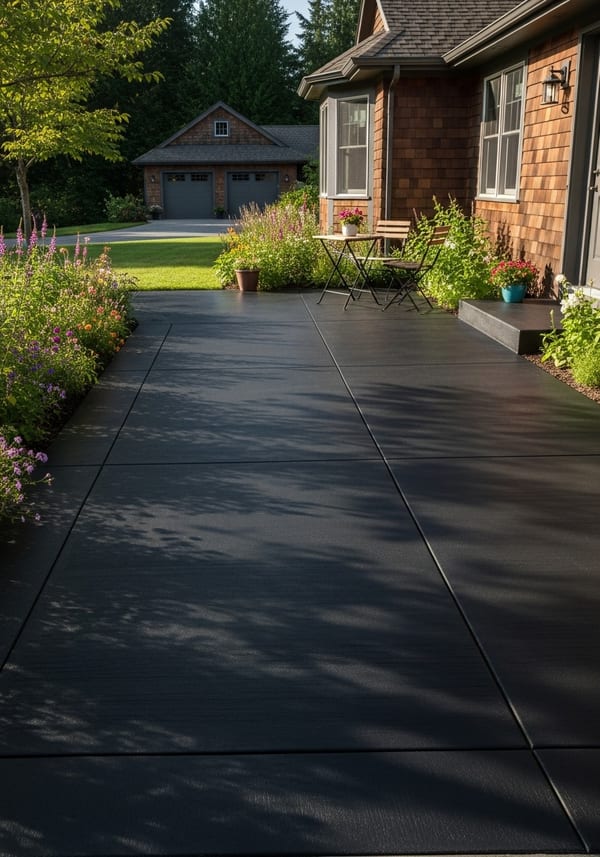
A charcoal concrete driveway is plain concrete with dark grey integral color mixed in. As of 2026, plain concrete runs $6–12 per sq ft installed, or $3,000–6,000 for a 500 sq ft driveway, before pigment. Charcoal reads nearly black from the street, needs far less pigment than a saturated black, and shows dust and efflorescence less.
Charcoal or Black: Which Shade Fits Your Driveway?
Charcoal and true black come from the same pigments at different doses. The difference shows up in three places: surface heat, how the color ages, and how much everyday dirt you see.
| Factor | Charcoal grey | True black |
|---|---|---|
| Pigment needed | Low to mid loading (about 1–2% of cement weight) | High loading (about 4% and up, near the ~7% saturation point) |
| Surface heat | Hot, but reflects more sunlight than black | Hottest; closest to asphalt |
| Fade behavior | Changes are less visible against a mid-dark base | Any lightening, wear or lime bloom stands out |
| Dirt and dust | Hides dust, sand and light tire marks | Shows pale dust, salt residue and efflorescence |
Loadings follow the Solomon Colors card, which shows its 920 black pigment at 1% (Slate), 2% (Smoke) and 4% (Onyx) of cement weight, with 7% as the saturation point (Solomon Colors integral color card). On heat, new grey concrete reflects 30–50% of sunlight and new asphalt about 5% (LBNL Heat Island Group). LBNL researchers estimated that every 10 percent increase in solar reflectance lowers surface temperature by about 7°F (EPA Cool Pavements Compendium). Charcoal sits between grey and black on that scale, so it runs cooler than black but warmer than plain grey. On dirt, LANXESS notes that white lime deposits are more noticeable on colored concrete than on grey (LANXESS), and the darker the slab, the stronger that contrast. If you want true black rather than charcoal, our black concrete driveway guide covers that look, its cost and its upkeep in full.
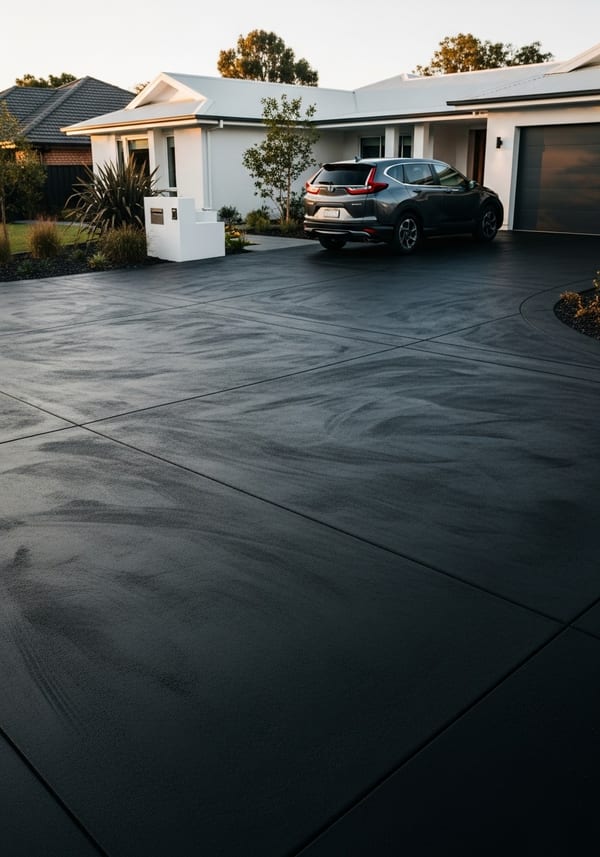

Charcoal Grey Integral Color Shades and Dosage
Integral color is sold by shade name, but what you are really choosing is a pigment and a dose. The Solomon Colors card is a useful reference because it shows the same pigment at three loadings:
| Shade (Solomon card) | Pigment | Loading | Bags (25 lb) | Reads as |
|---|---|---|---|---|
| 920 Slate | 920 black | 1% | 1 per 4 yd | Mid grey |
| 920 Smoke | 920 black | 2% | 1 per 2 yd | Charcoal grey |
| 920 Onyx | 920 black | 4% | 1 per 1 yd | Near black |
| 908 Lunar Eclipse / Asphalt / Ultra Black | 908 carbon black | Lower doses | 1 per 4, 3 or 2 yd | Charcoal to black |
Two caveats from the same card matter for a driveway. The chips show unsealed concrete made with medium grey cement, and a sealer may darken the color, so the finished driveway will usually read darker than the chip. The 908 carbon black can reduce the entrained air in the mix, which matters where driveways freeze, and Solomon recommends sealing carbon-black concrete because the carbon tends to dissipate over time (Solomon Colors). Carbon black has two to five times the tinting strength of iron oxide black but can weather out of exterior concrete (Concrete Decor). For a low-maintenance charcoal, ask for an iron oxide black at a stated dose and a test panel. To see charcoal next to trim and siding colors, browse the charcoal driveway palette.
How Charcoal Reads on Broom, Exposed Aggregate and Smooth Finishes
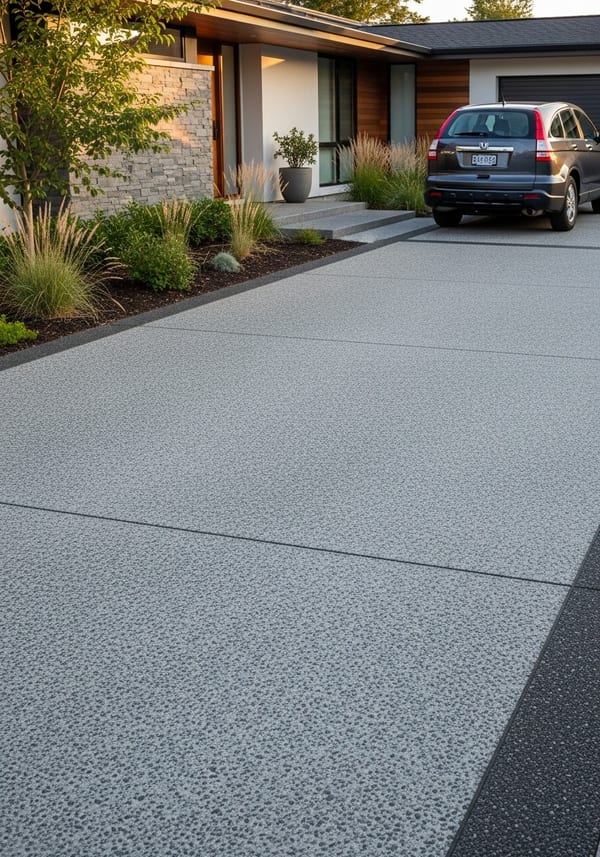
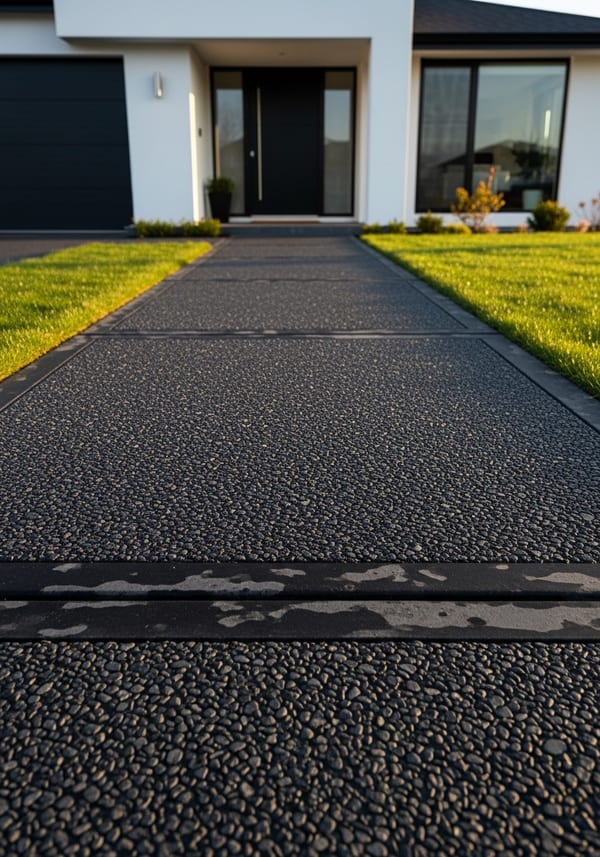
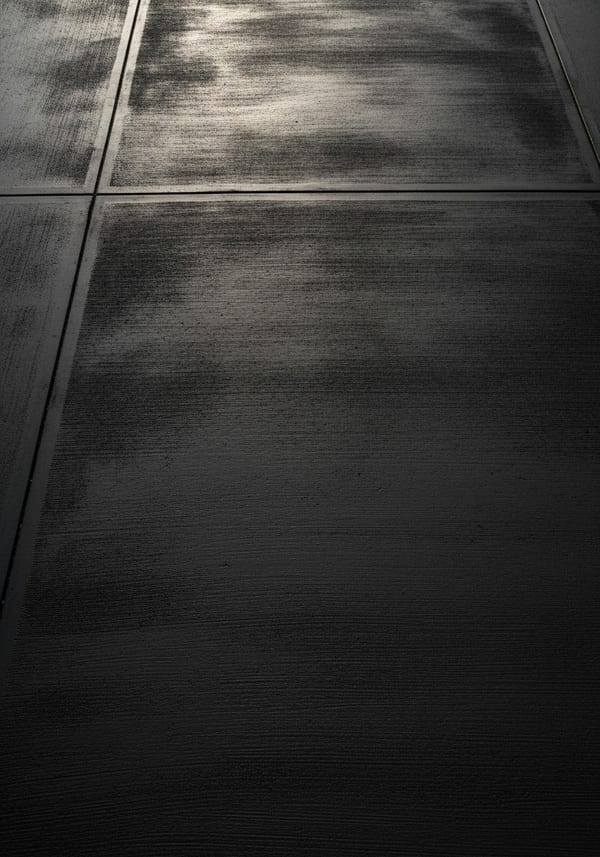
The same charcoal mix looks different depending on the finish. Texture changes how light hits the surface, and some finishes put aggregate, not paste, on top.
| Finish | How charcoal reads | Traction | Best use |
|---|---|---|---|
| Light broom | Even mid-dark grey; the fine grooves soften the tone | Good | Most driveways, slopes, freeze-thaw areas |
| Exposed aggregate | Charcoal paste behind visible stone; the stone color takes over | Very good | Busy driveways where dirt hiding matters |
| Smooth / troweled | Deepest, most uniform charcoal | Lowest; slick when wet | Flat, dry-climate sites only |
LANXESS explains why exposed aggregate shifts: once the surface paste is removed or weathers away, the aggregate particles contribute more to the overall color (LANXESS). Pick a dark basalt or grey stone if you want the driveway to stay charcoal; a tan pea gravel pulls it warm. The same document notes that a higher water-cement ratio makes concrete look lighter, so a wet, sloppy pour can produce a washed-out charcoal. Solomon's card asks for a 4-inch slump and the same mix design, plant and materials for the whole job to keep color consistent (Solomon Colors).
Charcoal Concrete Driveway Cost: Plain, Exposed and Stamped
Charcoal is a color, not a finish, so cost depends on the finish underneath. National installed ranges per sq ft (see our methodology) for patio and walkway work, before pigment:
| Finish | Installed per sq ft | 300 sq ft single-car | 500 sq ft two-car |
|---|---|---|---|
| Plain concrete (broom or smooth) | $6–12 | $1,800–3,600 | $3,000–6,000 |
| Exposed aggregate | $8–16 | $2,400–4,800 | $4,000–8,000 |
| Stamped concrete | $8–28 | $2,400–8,400 | $4,000–14,000 |
Add the pigment on top. Integral color is priced per bag and dosed per cubic yard, so a charcoal at a 2% loading uses half the pigment of the same color at 4% (Solomon Colors); ask your contractor to quote color as a separate line. Driveway slabs are often thicker than patio slabs, which pushes costs toward the upper end of each range. Run your own dimensions in the patio cost calculator, or compare a dark paver driveway in the paver driveway cost calculator.
House Styles That Pair With a Charcoal Driveway
Charcoal is easier to pair than true black because it does not fight with grey roofs or dark window frames.
| House style | Charcoal approach | Why it works |
|---|---|---|
| Modern / contemporary | Smooth-edged broom slab with saw-cut grid | Matches flat planes and black window frames |
| Modern farmhouse | Charcoal broom with a lighter border band | Echoes white siding and black trim without going stark |
| Craftsman / traditional | Charcoal exposed aggregate or ashlar stamp | Texture keeps it from feeling too minimal |
| Mid-century ranch | Charcoal with wide scored panels | Low, horizontal lines suit the roofline |
| Dark-sided homes | Lighter charcoal (low loading) | Keeps some contrast between house and driveway |
For more pairings, see the charcoal driveway palette and our modern driveway ideas.

Charcoal Driveway Maintenance and Sealing
A charcoal driveway needs the same care as any concrete driveway, with extra attention to the sealer, because the sealer controls how deep the color looks.
- Seal after finishing. The Wisconsin Ready Mixed Concrete Association says a surface sealer should be applied after finishing (WRMCA).
- Skip deicers the first winter. WRMCA calls deicers one of the most damaging things for new concrete, especially the first winter, and says never to use ammonium sulfate or ammonium nitrate products. Use plain sand for traction.
- Reseal when wear shows. Butterfield warns that car traffic and deicing salts wear sealer faster, and that sealer buildup can cause delamination (Butterfield Color).
- Keep carbon black sealed. If your mix used carbon black, keep up a sealer program to slow the pigment working its way out (Solomon Colors).
- Wash off lime bloom early. Efflorescence is usually temporary and weathers away, but it shows more on colored concrete (LANXESS).
Making an Existing Grey Driveway Charcoal
Integral color only works on a new pour. For an existing slab, the options are a penetrating stain, a tinted sealer, or an overlay. A tinted sealer is the fastest route: Solomon notes that grey concrete can be colored just by adding a tinted sealer, and that most decorative acrylic sealers last two to three years (Solomon Colors). On driveways, wear patterns appear sooner, so plan on more frequent recoats and a clear topcoat (Concrete Network). If the slab is worn or cracked, a resurfacing overlay lets you add charcoal and a new texture in one step. For the full comparison of integral color, stain and tinted sealer, see the black concrete driveway guide.
Charcoal Driveway Ordering Checklist
- Name the pigment type (iron oxide or carbon black) and the dose as a percentage of cement weight in the quote.
- Ask for a test panel with the actual finish and sealer; sealer usually darkens the color.
- Use one ready-mix plant and one mix design for the whole driveway, and pour aprons with the same batch where possible.
- Choose broom or exposed aggregate on any slope; keep smooth troweling for flat, dry sites.
- Specify the sealer and the first-winter plan (sand, no deicers) before the pour.
Want pattern as well as color? See our black stamped concrete guide.